In order to embed the application process for a standard, uniform and transparent license to fell or transplant trees, which will allow optimal protection of the trees, the Ministry of Agriculture has formulated, in recent months, the draft regulations now published for public perusal and comments. The regulations set a new standard in the field and increase its accessibility to the general public. Inter alia, the regulations stipulate a new obligation of publishing, according to which signs must be placed in a prominent location near the tree that is the subject of the application, for 14 days, and to provide the public with an additional notification mechanism that will facilitate objections. In addition, the existing advertising mechanism on the website of the Ministry of Agriculture will be upgraded in a manner that will improve the interfaces with the public and increase its ability to take part in the process.
Moreover, the new regulations define how the value of the tree, for which an application is submitted, should be determined. This includes stipulating that each tree will be given a score according to four uniform criteria, in the range of 0-5 points for each criterion, including: The species of the tree; the location of the tree; its environmental contribution; and its condition. This score will serve as the basis for the reasoned decision of the forest officer, which will be submitted within 30 days of the date of receipt of all the required documents.
The regulations also stipulate that, as a general rule, a felling license that has been granted will require the replacement planting of a tree, in accordance with the value of the tree determined by the forest officer. To the extent that the forest officer believes that a replacement planting cannot be carried out, due to environmental conditions or special circumstances, he will set, in the license conditions, a monetary levy as published in this section.
The regulations produce a more rigorous oversight mechanism by the Government Forest Officer in relation to the actions of felling or transplanting trees, as part of Local Authority development plans. This is effected through a control and approval mechanism of plans that details the development activities that are planned to be carried out by the Authority and involve the felling or transplanting of trees. The plans will be submitted for review and approval by the Government Forest Officer and, after their approval, it will be possible to issue licenses that comply with what is stated in them, depending on the progress of the implementation of the plan.
The Government Forest Officer at the Ministry of Agriculture and Rural Development, Dr. Erez Barkai, stated: “Felling a tree is an irreversible step, and therefore requires a reasoned and uniform consideration process. We, at the Forest and Trees Division of the Ministry of Agriculture, are currently piloting a broad move to increase transparency throughout the process, in order to expand the public’s ability to take part in it. To date, the Ministry of Agriculture has operated through work procedures, which have established methods of action in the field, and supervisory and audit mechanisms. The new regulations enshrine a common and uniform language for forest officials throughout the decision-making process, which will certainly streamline their work and create standardization in the field but, no less importantly, they effectively regulate the work of regional forest officers, alleviate the bureaucratic burden resting on the shoulders of the public and maximize the value of protecting trees.”
What problem do we address? Какую проблему мы решаем?
More than 85% of the territory of Uzbekistan is occupied by deserts and semi-deserts, which have the tendency to expand rather rapidly. At COP27, it was acknowledged that the average warming rate in Uzbekistan is two times higher than the global average, glaciers are not replenishing fast enough, and water resources are becoming even more scarce. Reliance on the annual precipitation to replenish water aquifers is not sustainable in view of the decrease of precipitation and growing demand for water.
Более 85% территории Узбекистана занимают пустыни и полупустыни, имеющие тенденцию к быстрому расширению. На саммите по климату COP27 было признано, что средние темпы потепления в Узбекистане примерно в два раза выше, чем в среднем по миру, ледники пополняются недостаточно быстро, а водные ресурсы становятся еще более дефицитными. Использование годовых осадков для пополнения водоносных горизонтов не является устойчивым ввиду уменьшения количества осадков и растущего спроса на воду.
Water scarcity poses major food security risks and shortage of employment. Scarcity of water resources as a source of security risks in Central Asia has been well documented and researched.
Маловодье создает серьезные риски для продовольственной безопасности и является причиной нехватки рабочих мест. Дефицит водных ресурсов как источник угроз безопасности в Центральной Азии хорошо задокументирован и исследован.
In the Soviet times, there were plans of diversion of Siberian rivers to Central Asia. Such plans were stopped due to serious objections from environmentalists and economists. It means that the solution of the water scarcity problem lies entirely within Uzbekistan, the solution, which will stop the damage to its nature and to its human development.
В советское время существовали планы отвода сибирских рек в Центральную Азию. Однако такие планы были остановлены из-за возражений со стороны экологов и экономистов, а это значит, что решение проблемы нехватки воды полностью зависит от самого Узбекистана, решение, которое остановит ущерб его природе и его человеческому развитию.
2. How do we propose to address it? Как мы предлагаем решить эту проблему?
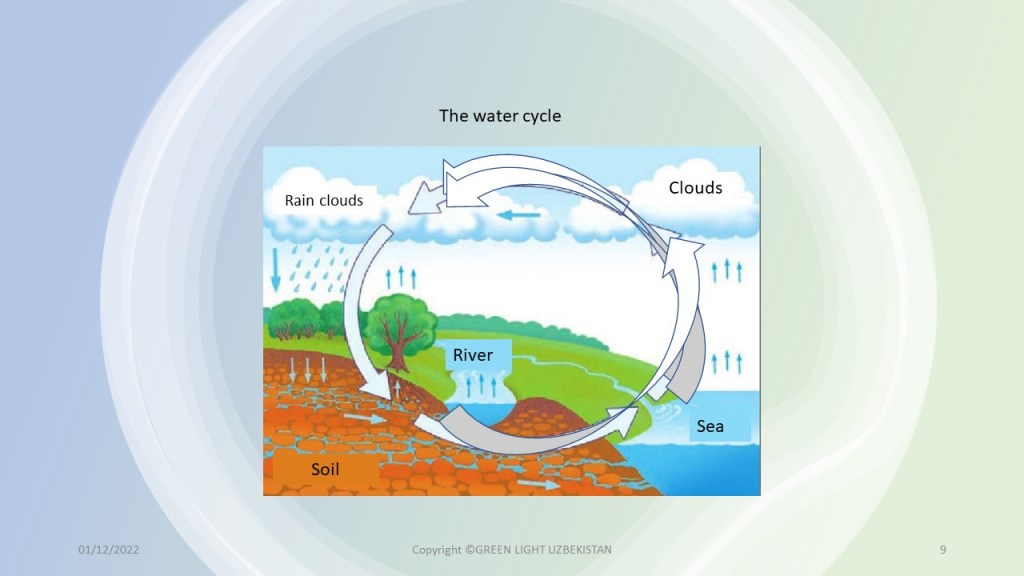
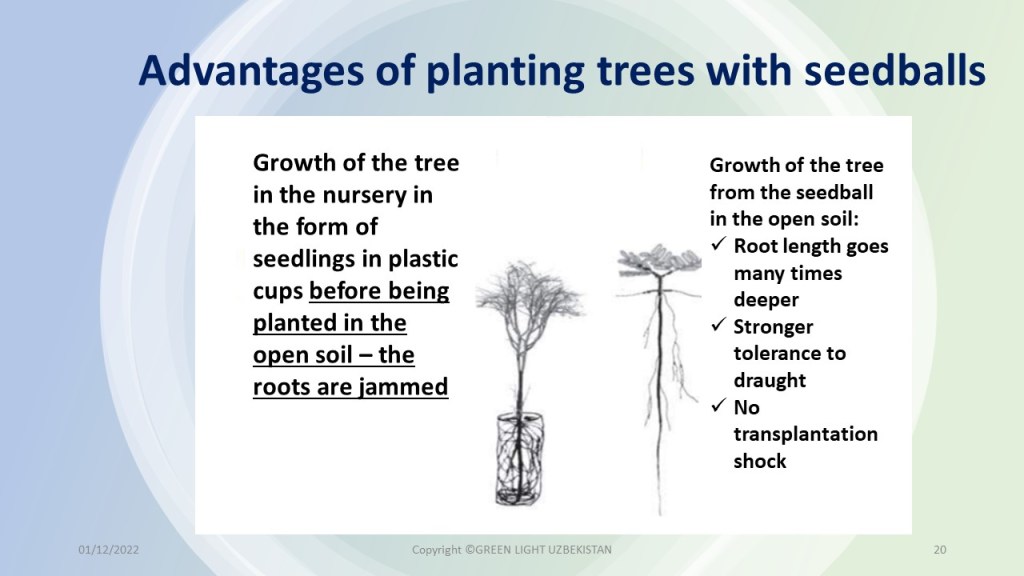
75% of fresh water supply in the world comes from forests. Forests add moisture to the air and create clouds. Trees draw water from aquifers via roots all the way to their leaves where it is evaporated – a process called transpiration. At the same time, the tree leaves release friendly bacteria that trigger the airborne water vapor to cluster together, forming clouds. These clouds also attract higher clouds in the sky that would have otherwise passed over these regions, combining with them to bring additional rain to the forest. This process circulates water from deep underground, into the air, and back down to the earth. Thus, even forests located far from large water bodies produce rainfall. Forestation implies not only planting and growing endemic trees but the accompanying natural growth of saplings from roots or seeds of the growing trees, other vegetation sprawling around the planted trees with the relevant biodiversity, which ensures the sustainability of forests.
75% запасов пресной воды в мире поступает из лесов. Леса увлажняют воздух и создают облака. Деревья втягивают воду от корней до листьев, где она превращается в водяной пар и испаряется — процесс, называемый транспирацией. В то же время листья деревьев выделяют полезные бактерии, которые заставляют переносимые по воздуху водяные пары собираться вместе, образуя облака. Эти облака также привлекают более высокие облака в небе, которые в противном случае прошли бы над этими регионами. Объединяясь с ними, водяные пары создают дождевые осадки над лесом. Этот процесс обеспечивает циркуляцию воды из глубоких подземных слоев в воздух и обратно на землю. Таким образом, даже леса, расположенные вдали от крупных водоемов, производят осадки. Облесение подразумевает появление биоразнообразия, которое необходимо для обеспечения устойчивости лесов.
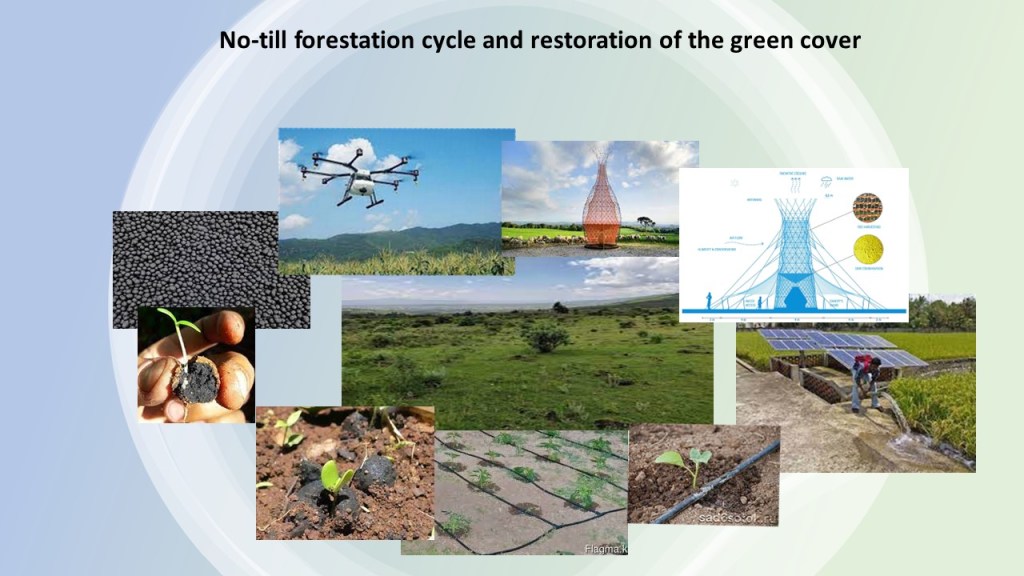
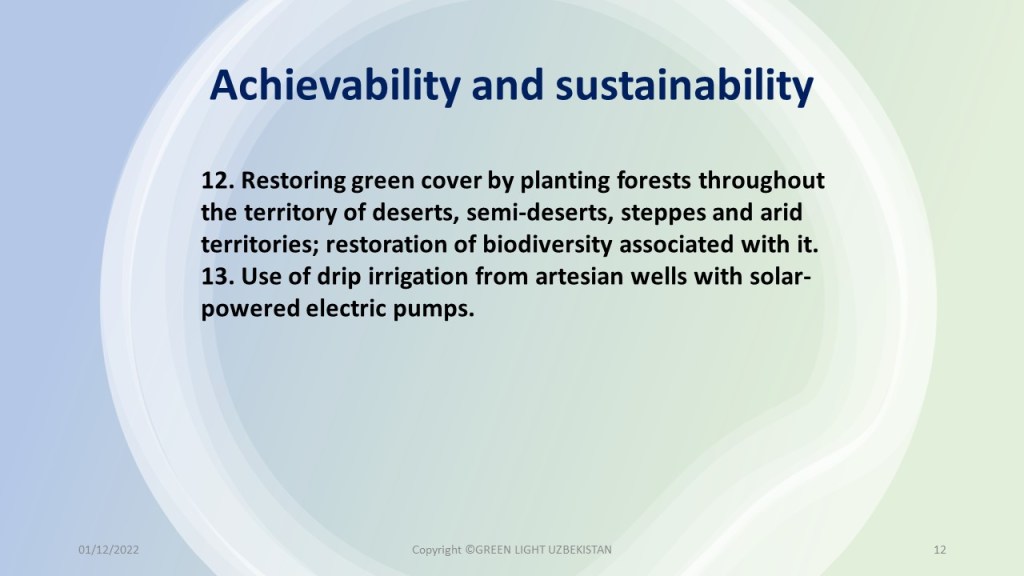
Water scarcity in Uzbekistan must be addressed through the afforestation of large land areas by using capillary irrigation from artesian water wells with solar powered pumps and atmospheric water condensation low-tech units. There are groundwater reserves under the deserts and semi-desert areas of Uzbekistan. That water will be needed temporarily before the radical roots of the trees reach the aquifers and take up water independently. After that, solar panels and batteries can be used by communities to satisfy their needs in electricity.
Дефицит воды в Узбекистане должен решаться за счет облесения больших площадей с использованием капиллярного орошения из артезианских скважин с насосами, работающими на солнечной энергии, и низкотехнологичными установками конденсации атмосферной воды. Под пустынями и полупустынями Узбекистана имеются запасы подземных вод. Эта вода понадобится временно, чтобы дать корням деревьев достичь водоносных горизонтов и самостоятельно качать воду.
On average adult trees uptake 200 litres of water daily and transpire 95% of it. Precipitation is usually expressed as an equivalent depth of water in mm across the land surface. 1 mm of precipitation means 1 litre of water per 1 sq. m of the ground.
In the era of terraforming, or earth-shaping, it is possible to make vast deserts and semi-deserts more habitable. For instance, in case of Uzbekistan, it is possible to achieve an extra 200 mm of precipitation per year by planting and growing 45 billion trees on 400,000 sq. km based on the ratio of 1 tree per 9 sq. m, which takes into account future growth of vegetation under the canopy and the offspring from roots.
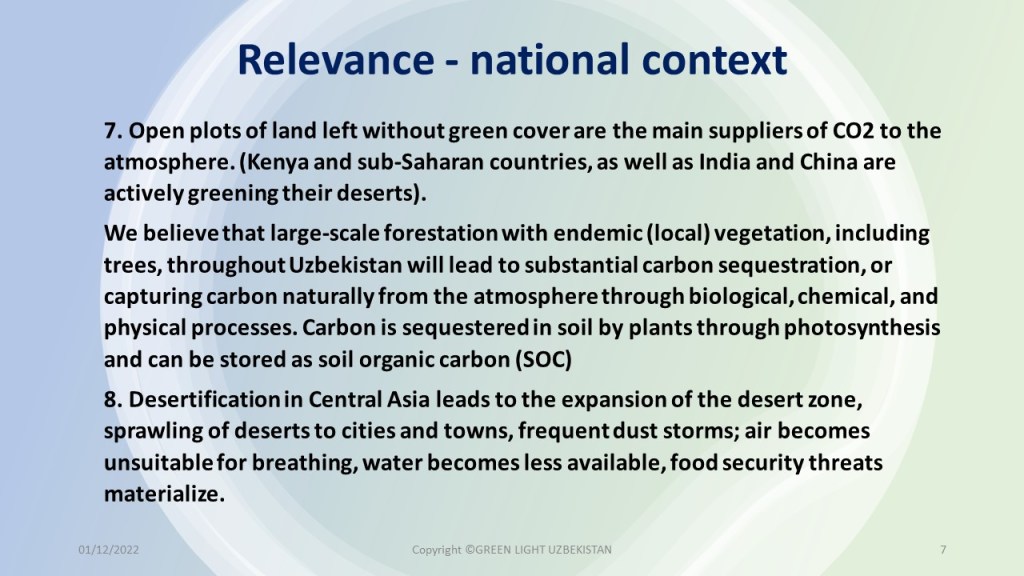
According to FAO, China had planted 220,000,000 ha, or 2,200,000 sq. km (2019), of forests with carbon storage value potential reaching 9.2 billion metric tons. India planted forests on 807,276 sq. km (2019). China and India each planted forests on the territory larger than Uzbekistan. These numbers tell us that the mission is possible.
Uzbekistan has already made impressive steps. In the Aralkum, a new desert in Uzbekistan, as of today, trees have been planted on 1,524,000 ha, or 15,240 sq. km, using two methods of propagation: the aerial seed-ball plantation and plantation of tree saplings.
In line with the proposed strategy, afforestation of Uzbekistan will result in the creation of massive carbon sinks. One tree sequesters a minimum of around 25kg of CO2 per year. Once grown, 45 billion trees will sequester 112.5 billion tons of CO2 per year. It means that Uzbekistan will gradually not only improve its climate, stabilize its water reserves but will also make Uzbekistan carbon-negative, sequestering more CO₂ than is emitted, which is crucial for the industrial development. Afforestation will not only help countries become greener but will also contribute to poverty reduction by households creating income from beekeeping, cocoon production and tree propagation. The betterment of public health will be achieved by forests preventing sand and dust storms and becoming sanctuaries of biodiversity and clean air.
В среднем дерево ежедневно с помощью корней потребляет 200 литров воды из водоносных горизонтов. 95% этой воды выбрасывается в атмосферу в результате транспирации, или дыхания дерева.
Количество осадков обычно выражается как эквивалентная глубина воды в миллиметрах на поверхности земли. Добавление или потеря 1 мм воды на площади 1 кв. м земли эквивалентна общему объему 1 литр.
Для получения дополнительных 200 мм осадков в год необходимо посадить и вырастить деревья из расчета 1 дерево на 9 кв. м, что означает 45 млрд деревьев на 85% территории Узбекистана или 400 000 кв. км, которые в настоящее время заняты пустынями и полупустынями.
По данным ФАО, в Китае было засажено лесами 77 157 000 га, или 771 570 кв. км. Индия посадила леса на 807 276 кв. км (2019 г.). Китай и Индия посадили леса на территории, превышающей территорию Узбекистана, что доказывает возможность терраформирования обширных пространств. В Аралкумах, новой пустыне Узбекистана, сделан большой шаг в этом направлении. На сегодняшний день там посажены деревья на 1 524 000 га, или 15 240 кв. км, с использованием двух методов облесения: аэропосева семенами и посадки черенков.
Важно отметить, что облесение Узбекистана приведет к созданию массивных поглотителей углерода. Если одно дерево поглощает минимум около 25 кг CO2 в год, 45 миллиардов деревьев будут забирать из атмосферы 112,500 миллионов тонн CO2 в год. Это означает, что Узбекистан постепенно не только улучшит свой климат, стабилизирует водный баланс, но и достигнет отрицательных показателей выброса. Узбекистан будет больше поглощать, чем выбрасывать СО2 в атмосферу. Это создаст резерв выбросов СО2, необходимый для индустриального развития Узбекистана.
It is feasible for Uzbekistan to create agroforestry clusters around communities with prevalence of food and forage forests of mulberry trees, almond, walnut, pistachio forests propagated with the help of tree cuttings and aerial plantation of trees, which do not bear fruit or nuts but support rich biodiversity beneficial for bees and insects beneficial for agriculture. All trees will play crucial role in maintaining biodiversity. Uzbekistan has gained a positive experience of forestation of the dried bottom of the Aral Sea, which is a reliable national precedent to be replicated in a more community-centred country-wide action. Households and communities taking part in the action will eventually form endemic seed-breeding farms and permaculture homesteads. Location of the current and future artesian wells will be mapped by hydrologists. Likewise, soil and forestation experts will draw up maps of suitable areas for the composition of forests.
Artesian wells will be equipped with solar-powered pumps and capillary irrigation systems. In the locations where artesian water is not available, other low-tech cost-effective methods of irrigation will be used, such as atmospheric water condensation units and hydrogel granules. In addition to hydrologists, this project will need soil specialists, forestation specialists, and citizen researchers to produce endemic forestation and groundwater irrigation maps. Timescale and extent of funding are part of the research as well as the institutional set-up of this action-oriented research and project aimed at restoring the biodiversity, endemic tree population and poverty reduction.
Для Узбекистана целесообразно создание агролесоводческих кластеров вокруг населенных пунктов с преобладанием плодовых и фуражных лесов таких деревьев как тутовник (шелковица), грецкий орех, фисташка, миндаль, боярышник, размножаемых с помощью черенков и аэропосева семян деревьев и кустарников, не приносящих плодов, но поддерживающих богатое биоразнообразие, полезное для пчел, таких как верблюжья колючка, тамариск, саксаул, породы деревьев тугайных лесов. Все деревья будут играть решающую роль в поддержании биоразнообразия. Узбекистан накопил положительный опыт лесонасаждения на высохшем дне Аральского моря, что является убедительным национальным прецедентом, который следует воспроизвести в масштабном общенациональном движении, ориентированном на сообщества. Домохозяйства и общины, участвующие в движении, со временем создадут эндемичные семеноводческие и пермакультурные хозяйства, объединятся в кооперативы и кластеры, создав условия для инвестиций.
Артезианские скважины будут оборудованы насосами на солнечных батареях и системами капиллярного орошения. В местах, где артезианская вода недоступна, будут использоваться другие низкотехнологичные экономичные методы орошения, такие как установки конденсации атмосферной воды и гранулы гидрогеля. Помимо гидрологов, этому проекту потребуются почвоведы, специалисты по лесоразведению и гражданские исследователи для создания карт эндемичных лесонасаждений и орошения подземными водами. Сроки и объем финансирования являются частью исследования, а также институциональной структуры этого проекта, одновременно ориентированного на практические исследования и на восстановление биоразнообразия, популяций эндемичных деревьев и сокращение бедности в сообществах.
3. What results do we expect and what is the projected cost?
Каких результатов мы ожидаем и какова прогнозируемая стоимость?
The brief list of the envisaged results includes relatively quick and large-scale climate change mitigation: stabilisation and sustainability of water resources, creation of carbon sinks, carbon offset for the country’s economic development, improved habitat for humans and rich biodiversity as part of sustainability formula. Creation of agroforestry clusters will facilitate the establishment of effective water replenishment mechanism, stronger food security, prevention of regional cross-border conflicts, major positive shift to “green economy”, growth of employment, poverty reduction, emergence of local women entrepreneurs from households headed by women engaged in the project, stronger social cohesion around the national idea of the ‘Yashil Makon’, or “Green Space” President’s initiative announced in 2021.
Краткий перечень предполагаемых результатов включает относительно быстрое и крупномасштабное смягчение последствий изменения климата: стабилизация и устойчивость водных ресурсов, создание поглотителей углерода, компенсация выбросов углерода для экономического развития страны, улучшение среды обитания человека и богатое биоразнообразие как часть формулы устойчивости. . Создание агролесомелиорационных кластеров будет способствовать созданию эффективного механизма восполнения водных ресурсов, укреплению продовольственной безопасности, предотвращению региональных трансграничных конфликтов, серьезному позитивному сдвигу в сторону «зеленой экономики», росту занятости, сокращению бедности, появлению местных женщин-предпринимателей из домохозяйств, возглавляемых женщинами, участвующими в проекте, укрепление социальной сплоченности вокруг национальной идеи инициативы президента «Яшил макон» или «Зеленого пространства», объявленной в 2021 году.
According to our calculations, the total budget for afforestation is 400 thousand square meters. km of territory is approximately US$9 billion, including networks of artesian wells, solar-powered thermal pumps, capillary irrigation system, formation of agroforestry clusters.
По нашим расчетам, общий бюджет облесения 400 тысяч кв. км территории составляет примерно
9 миллиардов долларов США, включая сети артезианских колодцев, термальные насосы на солнечных батареях, системы капиллярного орошения, образование агролесоводческих кластеров.
Green Light Deserts LTD brings together communities, social partnerships with government, businesses, investors to strengthen circular economy and governance using a systemic approach to economic development designed to benefit businesses, communities, and the environment.
GreenLightDesertsLTD объединяет сообщества, социальные партнерства с правительством, частным сектором и инвесторами для укрепления цикличной экономики и эффективного управления, используя системный подход к экономическому развитию, направленный на благо бизнеса, сообществ и окружающей среды.
The word “national” replaced the word “colonial” in the Bolshevik rhetoric in the 1930-s while agriculture became a field of war against the resistance to the modernised imperial conquest of Central Asia by Russia. (to be continued)
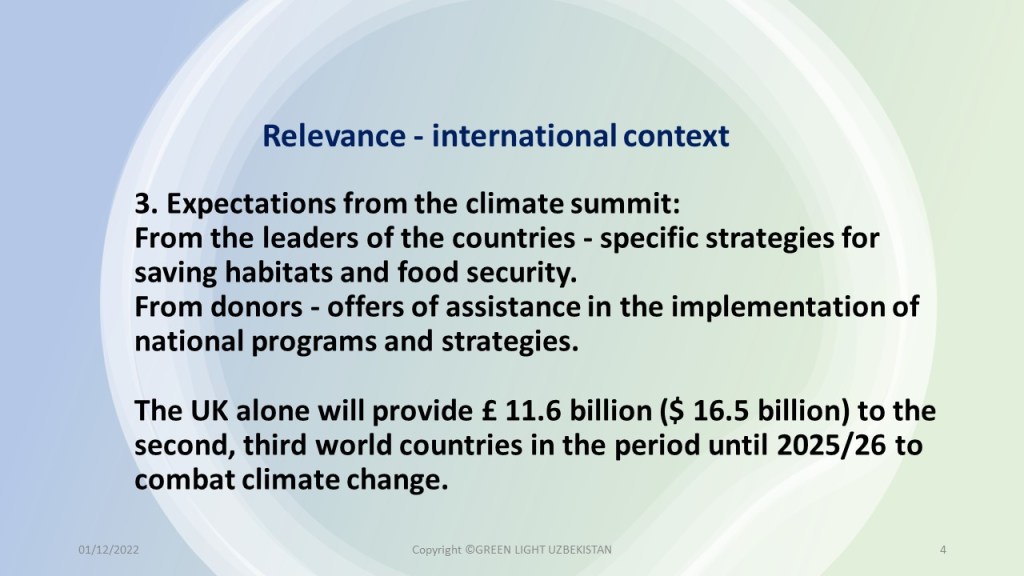
We are confident that challenges pose opportunities. Challenges faced by Uzbekistan whose 85% of the territory is covered by deserts and semi-deserts while 94% of its water resources are consumed by agriculture. At COP27 this November, it was confirmed that the average warming rate in Uzbekistan is twice higher than the global average, glaciers are not replenishing fast enough, and water resources are becoming even more scarce while the national contribution underlined the commitment to reduce carbon emissions and attain the necessary economic growth at the same time.
Numerous research by western and national scholars indicate that Uzbekistan possesses vast fossil water reserves under the deserts. Therefore, community-based forestation with endemic trees and shrubs, which possess food and forage value as well as bee-friendly features will be a way to go. “Zamin” Foundation’s “Green cities” and “Green belts” forestation strategy is focused on creating green spaces within communities, districts, regions and around them reaching out to the borders of Uzbekistan gradually filling up empty spaces, which need green cover.
The long-term goal is to soften the climate of Uzbekistan just through the endemic forestation, which will consequentially increase the annual precipitation and thus become a source of effective replenishment of water resources.
There are two interconnected investment opportunities to be launched with a grant:
Silk cocoon production clusters: Uzbekistan is the 3rd largest silk cocoon producer (with just 18K tons), with a 3% share of the global market, after China (403K tons), comprising approx. 67% of total volume and India (161K tons). Forestation and poverty reduction effort here is focused on planting mulberry trees for forage and food purposes along with other food forests of commercial significance, such as almond, walnut, pistachio forests with hawthorn, tamarisk, camelthorn, sea-buckthorn and other bee-friendly shrubs, which are endemic to Uzbekistan.
Solar electricity: Uzbekistan has at least 320 sunny days per year. The growth of the above forests will be supported by solar powered artesian wells and water saving capillary irrigation systems as well as seasonal water storing landscape manipulation techniques, such as swales, which are also good for forest fire prevention. Once the trees reach the water aquifers with their radical roots, artesian wells will not be needed, and solar panels and batteries can be used by local communities to satisfy their everyday needs and can be included in the electric grid or off-grid depending on the more suitable arrangements. After that, trees will become self-sustained and will activate the water cycle contributing to softening the dry climate of the area and creating vast carbon sinks.
The initial grant, or investment, should be about US$3 million with an upscaling investment potential of US$ 9 billion for the whole territory of Uzbekistan in the medium term.
The community-based approach will result in employment opportunities and growth of transformational entrepreneurship creating a demand conducive for the return of labour migrants to Uzbekistan from countries like Russia and Kazakhstan. The significance of this endeavor for the sustainable economic growth of Uzbekistan is comparable to the infrastructural breakthrough projects in the developed countries, such as the United States of the 1950s.
Uzbekistan upgraded its Intended Nationally Determined Contributions (INDC) to reduce greenhouse gas emissions per unit of GDP by 35% (instead of the previously envisaged 10%) by 2030 from the 2010 level. The main contributors to greenhouse emissions are energy industry — 76.3% and agriculture — 17.8%. It was documented in COP26 proceedings that by 2030, Uzbekistan pledges to increase its renewable energy output by 25% from the total energy output. It was acknowledged that the average warming rate in Uzbekistan is higher than the global average, glaciers are not replenishing fast enough, and water resources are becoming even more scarce. The emergence of the salt sand desert at the dry bottom of the Aral Sea, which is now called Aralkum, exacerbates the situation and negatively affects the environment of the country.More than 85% of 448,978 sq. km of the total territory of Uzbekistan are occupied by deserts
GREEN LIGHT DESERTS LTD is a Private Limited Company from LONDON UNITED KINGDOM and has the status: Active. GREEN LIGHT DESERTS LTD was incorporated 1 years ago on 21/09/2021 and has the registered number: 13633173.
This company is listed in the following categories: 74909 – Other professional, scientific and technical activities n.e.c.
This class includes a great variety of service activities … for which more advanced professional, scientific and technical skill levels are required, but does not include ongoing, routine business functions that are generally of short duration. This class includes: … agronomy consulting- environmental consulting- other technical consulting …
Description
This class also includes:- activities carried out by agents and agencies on behalf of individuals usually involving the obtaining of engagements in …the placement of books, …, artworks, photographs etc., with publishers, producers etc.
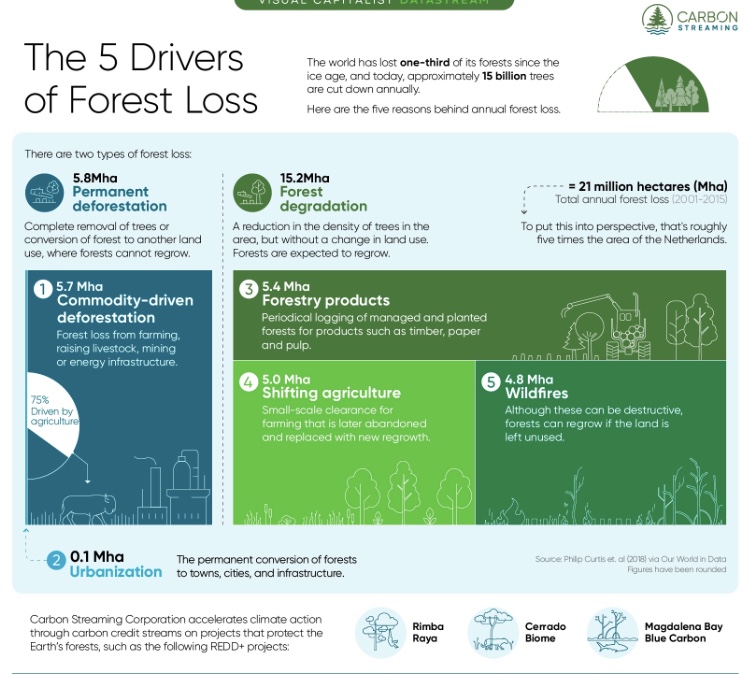
The Briefing On average, the world loses more than 20 million hectares of forests annually.
Agriculture and commodity-driven deforestation each account for approximately a quarter of annual forest loss.
Visualizing the Five Drivers of Forest Loss
The world has lost one-third of its forests since the ice age, and today, approximately 15 billion trees are cut down annually.
Forests are wellsprings of biodiversity and an essential buffer against climate change, absorbing billions of tonnes of carbon dioxide emissions every year. Yet, forest loss continues to grow.
The above infographic sponsored by Carbon Streaming Corporation highlights the five primary drivers behind forest loss.
Deforestation vs. Degradation
‘Forest loss’ is a broad term that captures the impacts of both permanent deforestation and forest degradation. There is an important distinction between the two:
Permanent deforestation: Refers to the complete removal of trees or conversion of forests to another land use (like buildings), where forests cannot regrow.
Forest degradation: Refers to a reduction in the density of trees in the area without a change in land use. Forests are expected to regrow.
Forest degradation accounts for over 70% or 15 million hectares of annual forest loss. The other 30% of lost forests are permanently deforested.
Driving factor Category Average annual forest loss (2001-2015, million hectares)
Commodity-driven deforestation Permanent deforestation 5.7
Urbanization Permanent deforestation 0.1
Forestry products Forest degradation 5.4
Shifting agriculture Forest degradation 5
Wildfires Forest degradation 4.8
Total N/A 21
Commodity-driven deforestation, which includes removal of forests for farming and mining, is the largest driver of forest loss. Agriculture alone accounts for three-fourths of all commodity-driven deforestation, where forests are often converted into land for cattle ranches and plantations.
The harvesting of forestry products like timber, paper, pulp, and rubber accounts for the largest share of forest loss from degradation. This process is often managed and planned so that forests can regrow after the harvest.
Shifting agriculture and wildfires each account for around 5 million hectares or one-fourth of annual forest loss. In both cases, forests can replenish if the land is left unused.
Urbanization—the conversion of forests into land for cities and infrastructure—is by far the smallest contributor, accounting for less than 1% of annual forest loss.
How Much Carbon Do Forests Absorb?
The world’s forests absorbed nearly twice as much carbon dioxide (CO2) as they emitted between 2001 and 2019, according to research published in Nature.
On a net basis, forests sequester 7.6 billion tonnes of CO2 equivalent (CO2e) annually, which equates to around 15% of global CO2e emissions. As the impacts of climate change intensify, protecting forests from deforestation and degradation is increasingly critical.
The Briefing
On average, the world loses more than 20 million hectares of forests annually.
Agriculture and commodity-driven deforestation each account for approximately a quarter of annual forest loss.
Visualizing the Five Drivers of Forest Loss
The world has lost one-third of its forests since the ice age, and today, approximately 15 billion trees are cut down annually.
Forests are wellsprings of biodiversity and an essential buffer against climate change, absorbing billions of tonnes of carbon dioxide emissions every year. Yet, forest loss continues to grow.
The above infographic sponsored by Carbon Streaming Corporation highlights the five primary drivers behind forest loss.
Deforestation vs. Degradation
‘Forest loss’ is a broad term that captures the impacts of both permanent deforestation and forest degradation. There is an important distinction between the two:
Permanent deforestation: Refers to the complete removal of trees or conversion of forests to another land use (like buildings), where forests cannot regrow.
Forest degradation: Refers to a reduction in the density of trees in the area without a change in land use. Forests are expected to regrow.
Forest degradation accounts for over 70% or 15 million hectares of annual forest loss. The other 30% of lost forests are permanently deforested.
Driving factor Category Average annual forest loss (2001-2015, million hectares)
Commodity-driven deforestation Permanent deforestation 5.7
Urbanization Permanent deforestation 0.1
Forestry products Forest degradation 5.4
Shifting agriculture Forest degradation 5
Wildfires Forest degradation 4.8
Total N/A 21
Commodity-driven deforestation, which includes removal of forests for farming and mining, is the largest driver of forest loss. Agriculture alone accounts for three-fourths of all commodity-driven deforestation, where forests are often converted into land for cattle ranches and plantations.
The harvesting of forestry products like timber, paper, pulp, and rubber accounts for the largest share of forest loss from degradation. This process is often managed and planned so that forests can regrow after the harvest.
Shifting agriculture and wildfires each account for around 5 million hectares or one-fourth of annual forest loss. In both cases, forests can replenish if the land is left unused.
Urbanization—the conversion of forests into land for cities and infrastructure—is by far the smallest contributor, accounting for less than 1% of annual forest loss.
How Much Carbon Do Forests Absorb?
The world’s forests absorbed nearly twice as much carbon dioxide (CO2) as they emitted between 2001 and 2019, according to research published in Nature.
On a net basis, forests sequester 7.6 billion tonnes of CO2 equivalent (CO2e) annually, which equates to around 15% of global CO2e emissions. As the impacts of climate change intensify, protecting forests from deforestation and degradation is increasingly critical.
Мы часто слышим как Узбекистан сравнивают с Китаем, Турцией, Индией, африканскими странами, когда речь заходит о посадке деревьев. Пример других стран нужен только для того, чтобы понять, что Узбекистан тоже может серьезно заняться облесением. Однако Узбекистан не нуждается в сходстве с другими странами. Ему нужно как можно скорее – в ближайшие годы – вырастить максимальное количество лесов, чтобы увеличить количество осадков. Ледники, питающие реки Узбекистана, не восполняются в достаточной мере. Пополнять существующие запасы водных ресурсов, улучшить и увеличить площадь плодородных земель можно только за счёт облесения пустынь, равнин, населённых пунктов и даже гор.
Под пустынями Узбекистана есть залежи воды. Как только деревья дотянутся корнями до водоносного горизонта, дальше они обеспечивают себя водой, а также заводят механизм циркуляции воды в природе за счёт транспирации, испарения воды с поверхности листьев. Леса, находящиеся вдали от крупных водоёмов, могут таким образом сами генерировать осадки. Я изучаю эту тему не первый год. Это не только возможно, но и других способов справиться с ухудшающейся ситуацией с маловодьем не существует.
Капельное и капиллярное орошение необходимо для того, чтобы взять воду взаймы у природы, чтобы эта вода вернулась сторицей, когда вырастут леса. Чтобы увеличить количество осадков на 200 мм, нужно вырастить дополнительно 45 миллиардов деревьев из расчета 9 кв м на одно дерево. 9 кв м*45,000,000,000 = 405 000 000 000 м2 = 405 000 кв километров. А территория Узбекистана, как вы знаете, 447 000 кв км. так что это реалистично.
Да, это значительно смягчит климат в Узбекистане, да и выглядеть он будет по-другому. Состояние пустыни является для природы стрессовым, вынужденным состоянием, а не тем, что нужно защищать и отстаивать. Может быть можно оставить какие-то незначительные ареалы пустынь, но в целом, нам жизненно необходимо покрыть Узбекистан лесами. Желательно, чтобы леса состояли из эндемичных деревьев, которые не боятся солёных и засушливых почв, но выбор деревьев должен быть привязан к конкретному региону, предпочтение должно отдаваться деревьям, полезным для сообществ, чтобы они были заинтересованы в посадке деревьев и уходе за ними. Узбекистан делает первые шаги по озеленению. Это радует!
Однако озеленение в Узбекистане проводится параллельно с неконтролируемой вырубкой существующих деревьев. Это самая тревожная особенность нашей реальности.
На самом деле лиственные деревья deciduous trees абсолютно и жизненно необходимы для восстановления и улучшения качества обедненных почв, почв больных эрозией, которые потеряли плодоносный слой – гумус – самую ценную часть, которая даёт название не только почве – источнику жизни, но и человеку. Humus, human, homo – это однокоренные слова. В конце концов, природа так устроила дерево, что, роняя вокруг себя листву, оно удобряет свою почву, роняя в неё семена, оно растит молодое поколение деревьев. Ну что тут сложного 🤷🏻♀️
Проблемы с воздухом в Узбекистане – от недостатка зелени и эрозии почв, когда весь почвенный углерод, который мы не смогли вернуть земле, оседает в лёгких.
Кроме этого в городах нужен строгий техосмотр выхлопной системы, фильтров автомобилей и мониторинг загрязнения воздуха автомобилями.

















 On average, the world loses more than 20 million hectares of forests annually.


 Green Light Deserts LTD