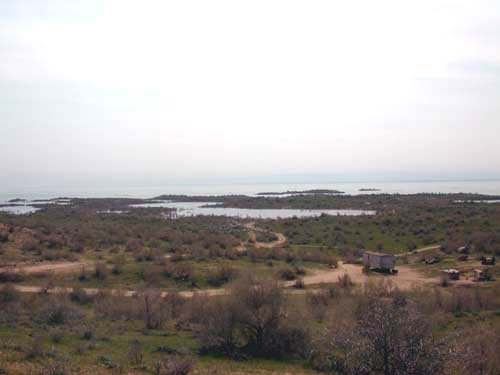
3-4 тысячи литров влаги в сутки испаряет один-единственный тополь. Зелёный массив деревьев создаёт охлаждающую транспирацию, как эффект потения. Эта влага притягивает и засасывает влажный горный и предгорный воздух. Работает механизм бриза.
Это всё описано, нужно говорить об этом, внедрять. Можно создавать дожди и увлажнять воздух вдали от морей и океанов. В контексте Узбекистана расширять ареалы существующих лесов. Процессу стремительного расширения пустынь нужно противопоставить процесс стремительного расширения площади лесов.
45 billion trees and solar panels for every household?
“The Earth 🌎 is the island and to save ourselves we rely on ourselves”, says the leader of Hawaii.
Almost all and Every rooftop has solar panels.
Hawaii is green but there is never enough green on the Green planet 🌎.
Hawaii planted 100 000 000 one hundred million trees in addition to the existing ones.
Territory of Hawaii is 28,412 square km.
Uzbekistan’s territory is 447,000 sq km. Roughly 20x of the size.
So, this number would be 100 mln x20 = 2 000 000 000 two billion for Uzbekistan.
However, to catch up with the existing green status of Hawaii, Uzbekistan needs 45 billion trees.
This will not only soften the extremely dry climate, it will help replenish the water resources by turning on the transpiration mechanism of forests, which deliver the water from the deep aquifers upwards and bring the produced precipitation downwards to feed the aquifers.
Why 45 billion? Because roughly 80% of the 447,000 sq km are devoid of the protective arborous cover, and it takes 1 adult tree per 9 sq meters to produce sustainable conditions for other vegetation and biodiversity around it.
Among the benefits is of course the vast carbon sink, which will create negative carbon footprint and freedom to develop carbon consuming and emitting industries much needed for its industrial development.
Also, installing solar panels on rooftops of the households in Uzbekistan is a national dream in both senses – daydream of the people and a night dream in which the decision makers are still in as far as solutions to sustainable development and employment are concerned 🤔
Thus, it can be said that Uzbekistan has the necessary technological means of reaching zero carbon emissions And developing its industries. #Keepitintheground
About materials published on this website
This work is licensed under a Creative Commons Attribution 4.0 International License.
Happy New Year! 🎄🎁✨❄️
Forestation and water resources. Background and current situation
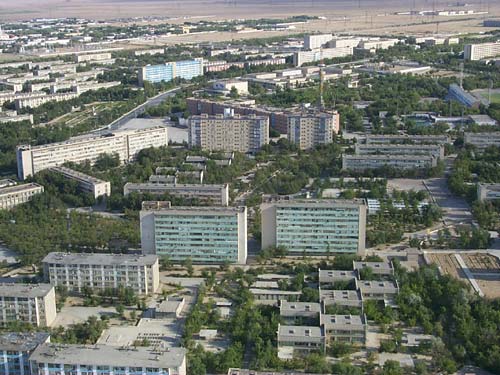
More than 85%[1] of the total territory of Uzbekistan (448,978 sq. km) is occupied by deserts and semi-deserts. It is these massive tracts of bare land that are the most significant sources of soil organic carbon (SOC) and СО2 emissions into the atmosphere compared to other sources due to sand dust storms[2] [3].
Droughts and scarce water supply lead to further desertification and dust storms, which have become more frequent in recent years. Currently, the dynamic of desertification is such that every minute quite a few square meters of land are added to the deserts in Uzbekistan.[4] Desertification in urban and agricultural areas is mainly manmade, which means it can be stopped and reversed. Dust, which raises into the air from desert and semi-desert soil settles in the lungs of people, in water, agricultural crops and all vegetation, dealing a lot of harm to the available resources and all people without exception even those who live in relatively comfortable urban conditions, let alone rural residents, especially those who live in the deserts, semi-deserts, steppe zones, and the Aral Sea basin. In addition to that, the glaciers storing freshwater reserves in the mountains of Tyan-Shan are melting too fast without sufficient natural replenishment due to climate change[5]. Also, the region of Central Asia will eventually face the consequences of the large-scale tree-cutting and wildfires in the taiga forests of Siberia, which are emitting tonnes of СО2 into the atmosphere in the form of tinder depletion, smoke, soot, and which are gradually leading to partial desertification of the places, which used to be forests.
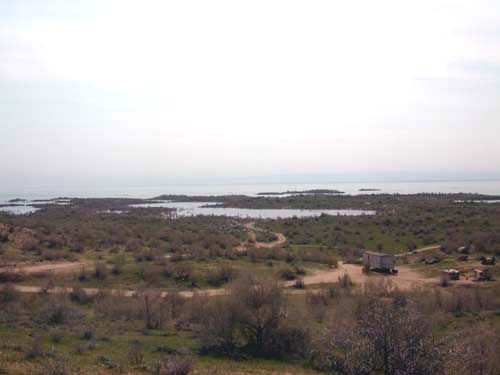
However, it is necessary to note that the main source of СО2 rising into the atmosphere is the open soil, the ground that is deprived of its cover whether vegetational or other. Arable farming also leads to massive loss of the organic layer due to the flight of the carbon into the atmosphere because of the perennial root elimination.[6] Gusts of wind raise into the atmosphere billions of tonnes of organic carbon, which is the essential component of the soil. The degradation of soils from unsustainable agriculture and other development has released billions of tons of carbon into the atmosphere.[7]
The attention given to the climate change in the world and significant funding allocated to tackle climate change open opportunities for Uzbekistan to solve the abovementioned issues.
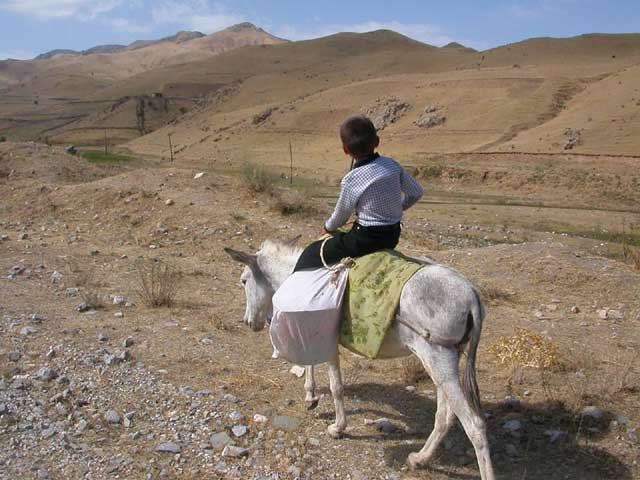
Based on the international practices and the national experience accumulated in Uzbekistan it was possible to develop and formulate a sustainable solution of the above-mentioned problems, which takes into consideration all aspects of the situation, such as an on-going desertification, water scarcity, air pollution, CO2 emissions, need for green jobs, green economy leading to a radical improvement of the situation in the foreseeable future.
National experience. Afforestation of the dried bottom of the Aral Sea as part of the action to mitigate the consequences of the environmental catastrophe is a good example of an enormous effort undertaken in a short period of time. It not only strives to catch up with the rapid pace of the climate change but also shows how much more needs to be done in the years to come. It is an excellent national pilot, which provides evidence-based results and lessons learnt opening avenues for scaling up the effort. In particular, the results of the aerial sowing method of the haloxylon plantations exceeded the outcomes of other methods by tens and hundreds of times proving to be much more cost-effective and less invasive for the soil, enabling faster and stronger growth of roots as compared to mechanical seeding or manual plantation of saplings in the sand furrows.[8]
International experience. Aerial sowing is very much in agreement with the method of afforestation in the so-called Green Belt of the Sahara Desert and other arid and semi-arid territories of Africa, India, and China. However, the aerial sowing in Africa and India is done with seed balls, or soil capsules with seeds of endemic trees, shrubs, and grass inside them. Since the ancient times, seedballs helped to protect future crops from birds and rodents and emulated enhanced natural conditions of growth for the seeds. Seedballs can be dropped onto the soil in any season of the year where they wait for the right temperature and a modest portion of precipitation to start growing up stems and putting down roots through the capillary ducts in the soil moving towards the deeper water aquifers. The composition of the soil for seedballs is very basic and may or may not include charcoal dusts, hummus, or other enriched protective mixtures.
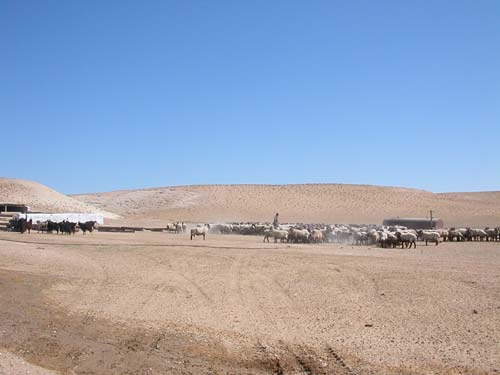
Currently Uzbekistan is working on the National Climate Change Mitigation Strategy until 2030, which will add to other important government directives in line with international cooperation and economic development while addressing environmental challenges[9]. However, the key to the solution of the problem of ameliorating and restoring the climate, the air and water quality, and land resources is the large-scale forestation of the whole territory of Uzbekistan.
It is not surprising that Bhutan[10] and Suriname[11] – two countries in the world with negative CO2 emissions are entirely covered with forests. To retain the carbon neutrality while developing the economy, it is necessary to design the development in such a way that carbon, which is the most important and precious natural element of life, is kept in the right places[12].
[1] According to the reliable data, more than 85% of the territory is affected by desertification not including the tugai and mountainous areas. Presentation of the report. https://unece.org/sites/default/files/2020-12/FR-Uzbekistan_Zakhadullaev_workshop%209%20December%202020.pdf
[2] McMahon, J. (2019) Why Agriculture’s Greenhouse Gas Emissions Are Almost Always Underestimated.
[3] Guo, M. et al (2012) The effects of sand dust storms on greenhouse gases. International Journal of Remote Sensing. https://www.researchgate.net/publication/254314458_The_effects_of_sand_dust_storms_on_greenhouse_gases
[4] Intensive desertification of the territory of Uzbekistan: causes, consequences, and solutions Интенсивное опустынивание территории Узбекистана: причины, последствия и выход (kun.uz)
[5] Chen, Y. et al. (2018) Satellite-based evaluation of the changes of glacial and terrestrial total water storage in the Tien Shan Mountains, Central Asia. https://ui.adsabs.harvard.edu/abs/2018AGUFMGC52C..02C/abstract#:~:text=The%20glaciers%20in%20Asia’s%20Tian,on%20water%20utilization%20and%20sustainability.
[6] Ontl, T.A. (2012) Soil Carbon Storage. Nature Education. https://www.nature.com/scitable/knowledge/library/soil-carbon-storage-84223790/
[7] Schwartz, J.D. (2014) Soil as Carbon Storehouse: New Weapon in Climate Fight? Yale Environment 360 Newsletter. Yale School of the Environment. https://e360.yale.edu/features/soil_as_carbon_storehouse_new_weapon_in_climate_fight
[8] Novitsky, Z. (2021) Green shield of the dried bottom of the Aral Sea. Publication dated 30 April 2021. https://www.gazeta.uz/ru/2021/04/30/aral-sea-region/
[9] In Uzbekistan, the foundation of the state policy on climate change consists of the Constitution of the Republic of Uzbekistan, UN Framework Convention on Climate Change, Paris Agreement on Climate Change, normative-legislative acts signed by the President and the Government of the Republic of Uzbekistan, such as, Law of the Republic of Uzbekistan “On the ratification of the Paris Agreement” (№ЗРУ-491 dated 02.10.2018.) https://lex.uz/docs/3924451 ; Law of the Republic of Uzbekistan “On the Use of the Renewable Energy” (№ЗРУ-539 dated 21.05.2019.) https://lex.uz/docs/4346835 ; Decree of the President of the Republic of Uzbekistan “On the adoption of the Concept of Environmental Protection of the Republic of Uzbekistan till 2030” (№УП-5863 dated 30.10.2019) https://lex.uz/ru/docs/4574010; Resolution of the President of the Republic of Uzbekistan “On the adoption of the Strategy of the Republic of Uzbekistan on Transition to “Green” Economy for the Period 2019-2030 (№ПП-4477 dated 04.10.2019.) https://lex.uz/ru/docs/4539506 ; Resolution of the Cabinet of Ministers of the Republic of Uzbekistan “On measures for Implementing the National Sustainable Development Goals and Targets” (№ПКМ-841 dated 20.10.2018) https://lex.uz/ru/docs/4013358 . Decree of the President of the Republic of Uzbekistan on the adoption of the agricultural development strategy for the period from 2020 to 2030 №УП-5853 dated 23.10.2019 https://lex.uz/ru/docs/4567337
[10] Munawar, S. (2016) Bhutan Improves Economic Development as a Net Carbon Sink. The Climate Institute.
[11] Suriname’s climate promise, for a sustainable future (2020) https://news.un.org/en/story/2020/01/1056422
[12] McDonough W. (2016) Carbon is not the enemy. Design with the natural cycle in mind to ensure that carbon ends up in the right places. https://www.nature.com/articles/539349a
Plant trees!
Is there future without trees?
Trees host insects, birds, and beasts
Trees host humans
Trees ARE the real hosts of the planet
They don’t need AC in summer, heater in winter
Plant trees. Birds and beasts save the trees
By eating fruits and dropping seeds
You think, birds and beasts drop seeds
Cos they’re stupid?
I wish humans were that kinda stupid
Cos our life depends on trees
Bees are dying, who pollinate 70% of our food!
You think bees pollinate trees to give you honey?
No, honey. They pollinate cos their life depends on trees. Read science. To save bees plant trees
We’re 7 billion humans on this planet
We cut 15 billion trees each year
To make beautiful notebooks with pictures of trees on them
To build beautiful houses with ACs and heaters in them
It takes 50 years for the Earth to establish one tree
Plant trees!
This planet has two Sons: The Treekind and The Humankind
Let’s be our Brother’s keeper!
Your neighbourhood is your Noah’s Ark. This time
YOU turn it into a forest or a garden!
Turn the food chain into a thought chain into a love chain into a life chain. Plant trees!
We know that pennies take care of pounds
We learn that trees take care of life
Breathable air, clean water, edible food, cozy shelter, education, #openfuture
Plant trees on your window sill
Plant trees in your garden, on your street
Plant trees in the mountains, in the fields
Plant trees Everywhere!
They will make Earth great again
Plant trees!
25 July 2018 @Svetlana Rakhimova
‘Friends, Plant Trees!’ (in the Uzbek language)
poem by Svetlana Rakhimova
Very concerned about tree cutting across the country. In the ancient times, Uzbekistan had dense tugay forests with wild animals in them. Now we call it oasis in the desert. And that oasis is shrinking because too many trees are cut in the cities as well as other areas of the country. Dust storms have become an ordinary phenomenon; hence the poem.
The poem has a refrain ‘Friends, Plant Trees!’
Дарахтлар экинг, дўстлар, дарахтлар!
Дарахтларнинг чиройи Ватан кўркидир
Қомати келишган чиноралардир
Дунёда танилган қайрағочлардир
Ўзбекистон она-еримизнинг Аллоҳга қараб
Дуо билан кўтарилган қўлларидир дарахтлар.
Сайёралар қарайди Ўзбекистонга
Юлдузлар милтирайди осмонларида.
Далаларнинг кўрки ахил тераклар
Япроқлари кулиб турган баланд тераклар
Бунёдкор ҳалқимизнинг чин дўстларидир.
Ёз чилласида ер иситмасини оладиган
Дарахт қўлларидир дарахт қўллари.
Баҳор кунларини одам кутади
Дарахт қўлларидан мева териб ейди
Соясидан баҳраманд бўлиб юради.
Дарахтлар экинг, дўстлар, дарахтлар!
Авлод аждодларимизнинг байроқларида
Баланд ва кўркам биноларида
Бадҳайбат ва қўрқмас йўлбарслари бор.
Эртак эмас улар. Қадим замонда
Йирик ўрмонларда яшаган улар
Қани энди ўша улуғ ўрмонлар,
Дарёларни асрайдиган йирик дарахтлар?
Дарахтлар экинг, дўстлар, дарахтлар!
Келажагимизниҳам улуғлайдиган
Дарахлардир, Ўзбегим, дарахтлар!
Чиноралар, қайрағочлар, олма, ўриклар.
Бағри кенг, камтарин, бой дарахтлар.
Раҳмдил, андиша, бунёд дарахтлар.
Ўзбекнинг кўнглига ўхшайди улар.
Дарахтлар экинг, дўстлар, дарахтлар!
2018 @ Svetlana Rakhimova
Best practice: Israel. Передовой опыт: Государство и общество на защите деревьев в Израиле
Израиль: Среди множества документов, необходимых для получения разрешения на вырубку или перемещение даже одного дерева, нужно предоставить письменные согласия от минимум 75% жильцов дома, если это многоквартирный дом и/или дерево находится на территории совместного владения.
Процедура обязательная даже для муниципальных властей. Никто, даже государство не может срубить дерево, если люди хотят его оставить.
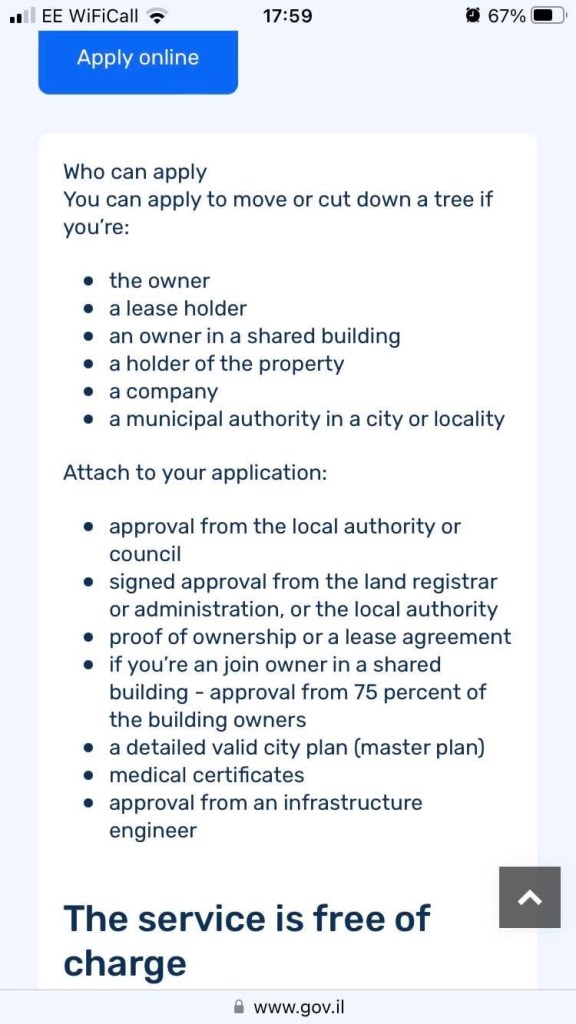
Who can apply
You can apply to move or cut down a tree if you’re:
the owner
a lease holder
an owner in a shared building
a holder of the property
a company
a municipal authority in a city or locality
Attach to your application:
approval from the local authority or council
signed approval from the land registrar or administration, or the local authority
proof of ownership or a lease agreement
if you’re an join owner in a shared building – approval from 75 percent of the building owners
a detailed valid city plan (master plan)
medical certificates
approval from an infrastructure engineer
Combating tree pruning cartel in Israel
Израиль: Уголовная ответственность за незаконную обрезку деревьев.
Combating tree pruning cartel
 Green Light Deserts LTD