Plants talk. Hopefully, artificial intelligence will help us understand them and all other living beings on the Earth. We should be able to communicate and understand each other and respect each others’ boundaries and collaborate and learn from each other.
Likewise, I hope the AI will help us get in touch and communicate with other intelligent civilisations without the need to visit them. Flying to extra far distances will require the depletion of the resources on the Earth. The AI uniting and bringing together all forms of intelligent life on the Earth, will help us “conquer” the universe intelligently without destruction, “conquer” meaning learn and benefit without detriment to anyone or anything. In fact, we should learn how to improve habitat instead of depleting it.
Trees host insects, birds, and beasts Trees host humans Trees ARE the real hosts of the planet They don’t need AC in summer, heater in winter Plant trees. Birds and beasts save the trees By eating fruits and dropping seeds You think, birds and beasts drop seeds Cos they’re stupid? I wish humans were that kinda stupid Cos our life depends on trees Bees are dying, who pollinate 70% of our food! You think bees pollinate trees to give you honey? No, honey. They pollinate cos their life depends on trees. Read science. To save bees plant trees We’re 7 billion humans on this planet We cut 15 billion trees each year To make beautiful notebooks with pictures of trees on them To build beautiful houses with ACs and heaters in them It takes 50 years for the Earth to establish one tree Plant trees! This planet has 2 Sons: The Treekind and The Humankind Let’s be our Brother’s keeper! Your neighbourhood is your Noah’s Ark. This time YOU turn it into a forest or a garden! Turn the food chain into a thought chain into a love chain into a life chain. Plant trees!
We know that pennies take care of pounds We learn that trees take care of life Breathable air, clean water, edible food, cozy shelter, education, #openfuture Plant trees on your window sill Plant trees in your garden, on your street Plant trees in the mountains, in the fields Plant trees Everywhere! They will make Earth great again
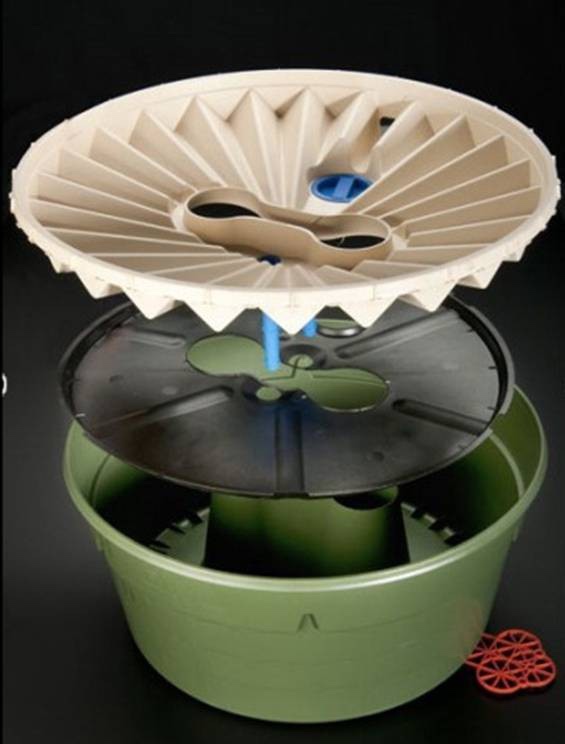
New technology allows you to grow forests even in the desert. An innovative device called Groasis Waterboxx allows you to grow plants in extreme conditions. Even in the Sahara Desert, about 90 percent of the Waterboxx assisted plants survive. The Waterboxx looks like a manual fruit and vegetable dryer, only without a lid. This device allows you to grow trees and bushes in places where there is no water and turn the desert into an oasis. The new technology allows you to grow forests even in the desert
Dutch inventor Pieter Hoff developed an innovative device called the Groasis Waterboxx. It allows you to grow plants in extreme conditions. Even in the Sahara Desert, about 90 percent of the Waterboxx-assisted plants survive. The Waterboxx looks like a manual fruit and vegetable dryer, only without a lid. This device allows you to grow trees and bushes in places where there is no water and turn the desert into an oasis.
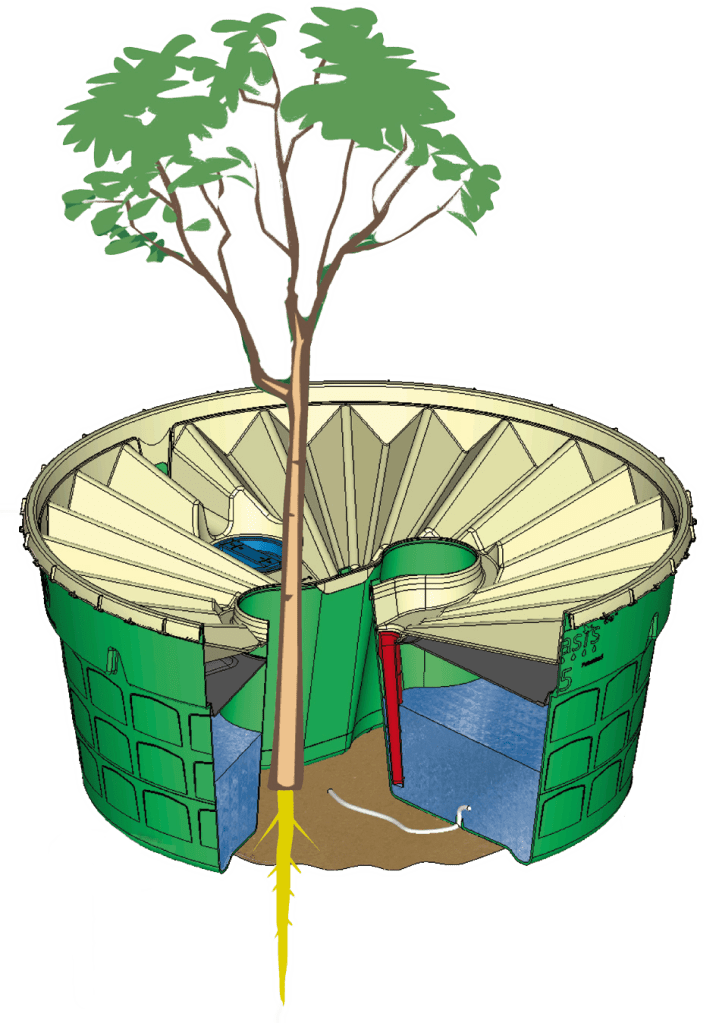
Waterboxx is a no-irrigation incubator that collects water from night dew or rainfall and then feeds the seedling with it for quite a long time. The container also prevents water from evaporating and protects the roots from the sun and from small rodents, keeps the rhizome at a constant temperature, which allows the trees to grow in a protected mode. Thanks to Groasis Waterboxx, the seedling no longer needs a planting hole: the capillary roots will always be intact, which will allow them to transfer moisture regularly and in the right amount to the future tree.
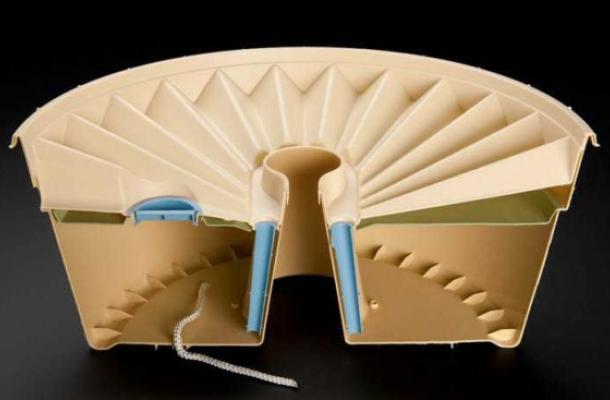
The new technology makes it possible to grow forests even in the desert. Each seedling is attached to a fabric or cardboard substrate inside the container and moisture enters the roots by capillary action. The system consists of a cylindrical body, which contains about 15 liters of water, and an inverted cone-shaped cover allows you to capture drains inside the body. In case of heavy rainfall, the device has a filling valve that draws out excess water. Inside each container there is a place for planting two seedlings.
Over the past five years, the Waterboxx system has been successfully implemented in five lifeless sites – deserts and former quarries with a total area of 65 hectares and the plant survival rate was 80-90 percent, although even 5 percent of the trees did not take root here before.
New technology makes it possible to grow forests even in the desert. Regular monitoring of plant growth was carried out using drones that scanned areas using thermal imagers. So it was possible to grow more than 25 varieties of trees and bushes and significantly increase biodiversity in a practically lifeless expanse. The first prototype of the device was made of plastic, but it was quickly replaced with recycled cardboard, which significantly reduced the cost of production. This invention can help combat hot and dry climates.
It is especially important for Uzbekistan to save every tree. Each new tree is a new life, and in general life for people.
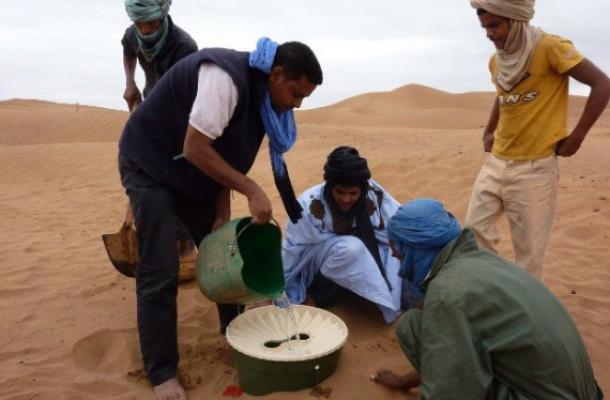
But back to our topic. The technology of Waterboxx is actively piloted in the world. In fact, it is a plastic (reusable) or biomass (biodegradable) box, with a hole for a seedling in the middle. Water is poured into the box. Out of the box, a synthetic lace comes out from the bottom, which, when filling the box with water, begins to transfer moisture from the box to the external environment, i.e. a sort of small dripper in the bottom of the box. Thus, water is very slowly supplied to the root zone of the seedling. From above, the Waterboxx is closed with a corrugated lid, with ribs. Condensed moisture, or precipitation, if any, also flows down these ribs into the box.
This technology was developed by Groasis specifically for landscaping arid areas. By planting a seedling of the desired type (remember, it is the species that is adapted for this territory), and placing a water box on top, filling it with water (in our case, it holds 17 liters), you actually provide the seedling with moisture for a very long hot period, and thus greatly increase its chances of survival. After the seedling has taken root, if it is of the type that is adapted to the given conditions, you can remove the water box and use it to plant the next seedlings.
That is why it is important to plant as many trees as possible. But don’t just plant. One of the most important things is not just to plant a tree, but to make it grow to an adult state. Of course, it is good when there are conditions and someone who will constantly water the planted tree. But this is often difficult, if not impossible. In our country, more than 80% of the territory is located in the arid zone, where you need to be especially considerate to each tree. And you need to create conditions so that each planted tree grows to an adult stage, when it does not require watering. It is clear that it is necessary to plant exactly those species that can grow in a given area and in given climatic conditions. We agree, is it not stupid to plant fur trees or poplars in an arid zone? It’s just stupid. They won’t grow there. The first rule that we keep repeating to everyone who wants to plant a tree is: “Look at what is already growing or has historically grown in this area. And plant these species! An indicator of the presence of trees of this species indicates that it is already adapted to the conditions, and the likelihood is high that newly planted seedlings of the same species will also survive here.
Figure 1. Waterboxx in section
The GEF SGP has approved two projects to see how this practice will help farmers in the arid regions of our country to increase the chances of the survival of planted trees. One of the projects is located in the Bakhmal district of the Jizzakh region, the second is in the Kitab district of the Kashkadarya region.
Our visit to the Bakhmal district did not give any results: the farmer did not have time to plant the planned seedlings. Will do it next year. But in the Kitab district there are results, and we want to share them with our readers.
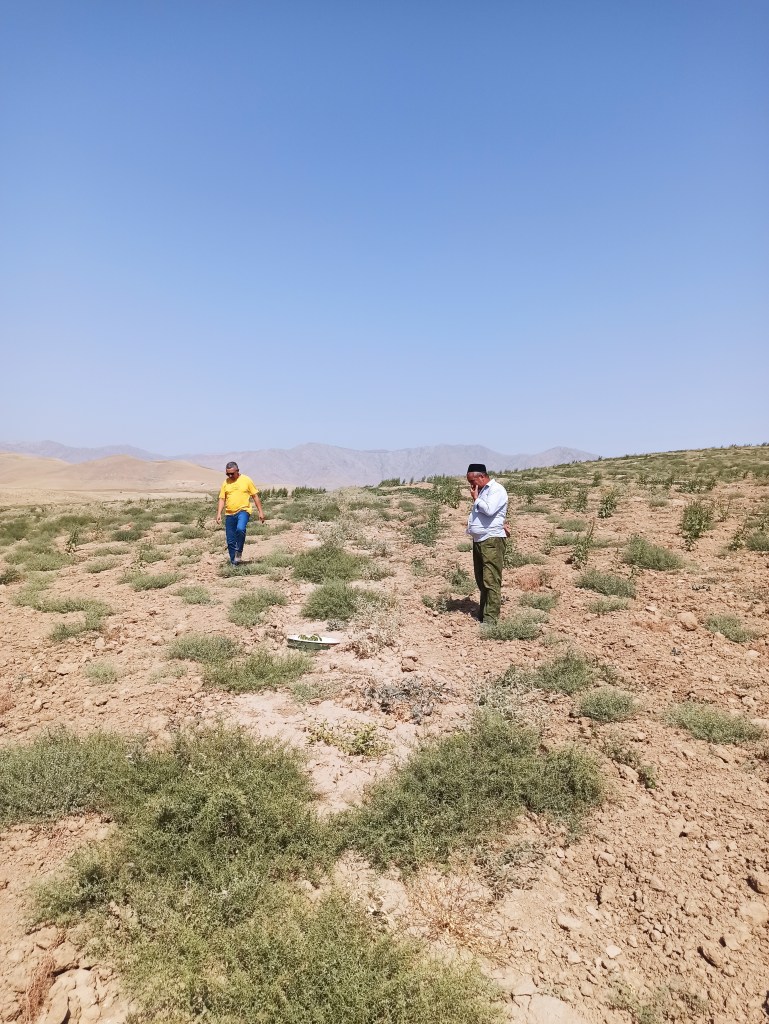
So, the farmer’s name is Sharafiddin Musaev. His land is on very arid rainfed foothills.
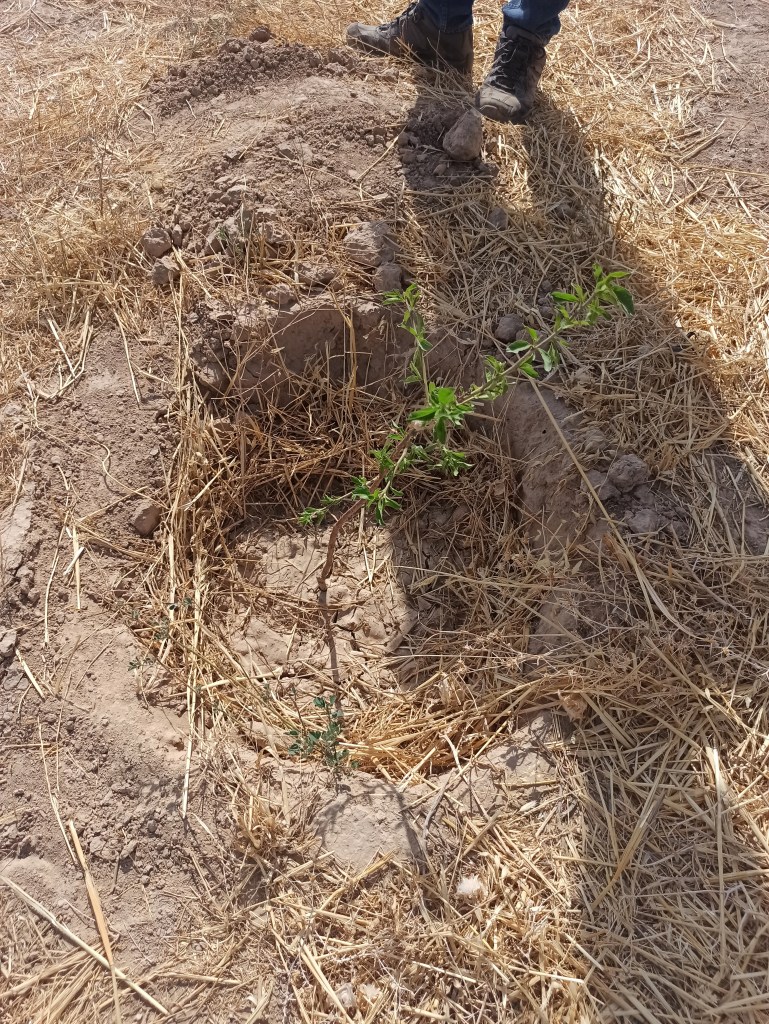
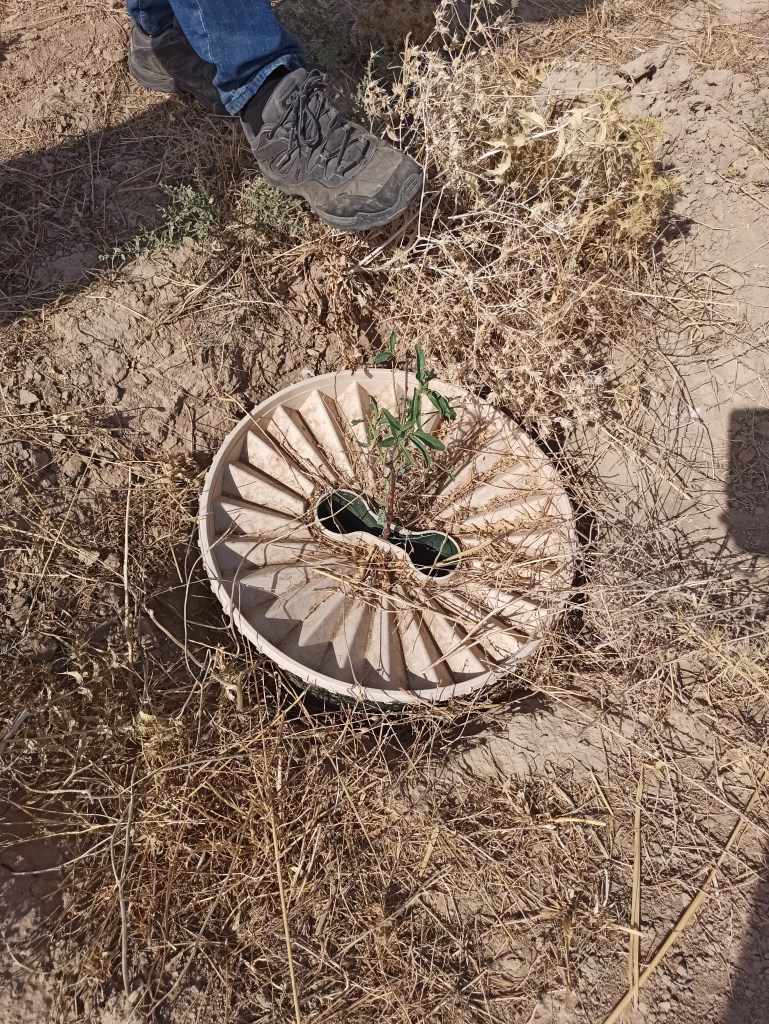
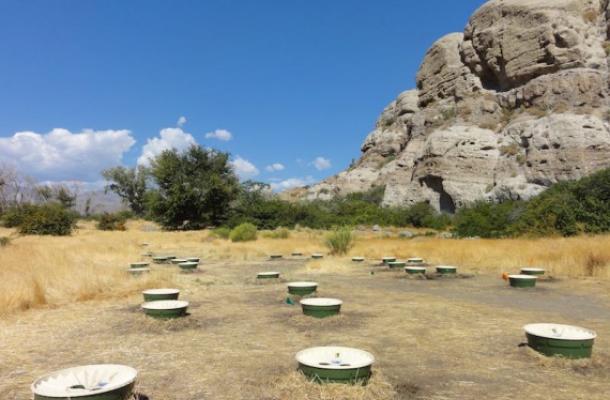
Photo of Sharafiddin-aka, and the water box (unfortunately, incorrectly installed, because the sides of the box were not covered, which did not prevent excessive evaporation)
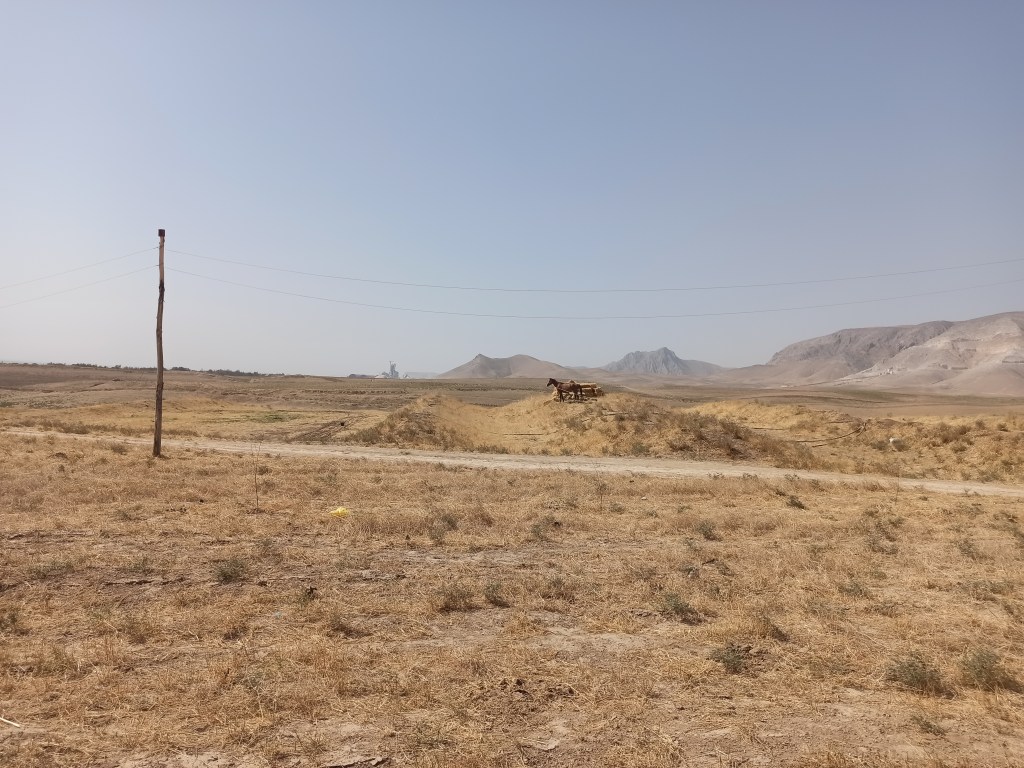
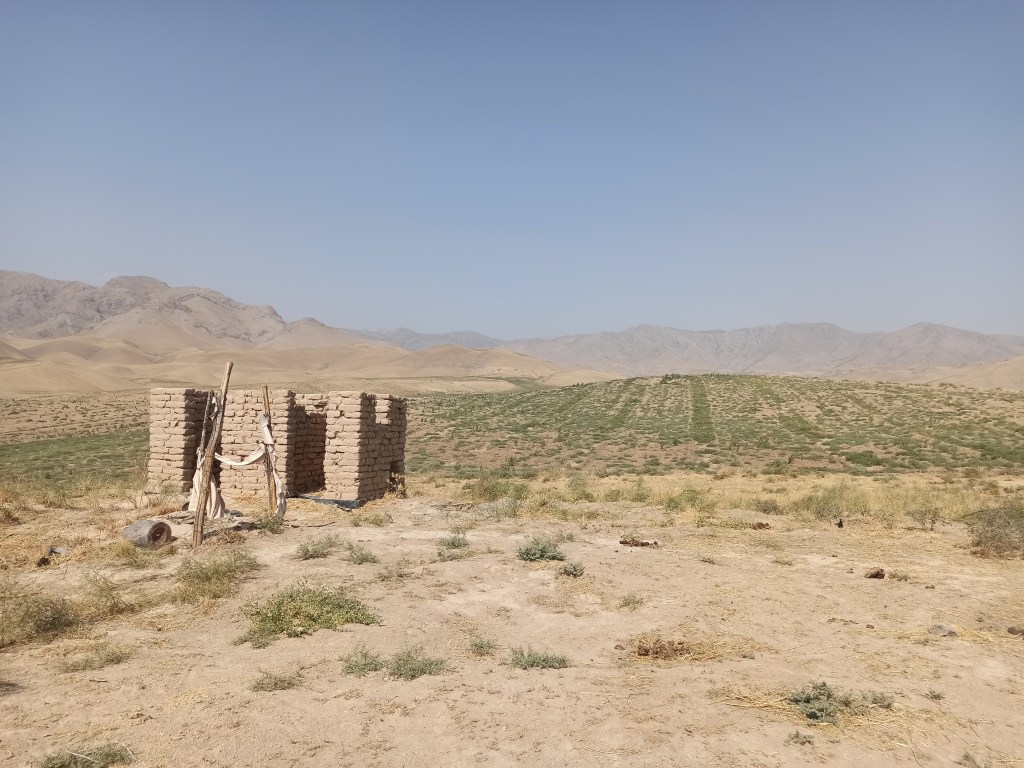
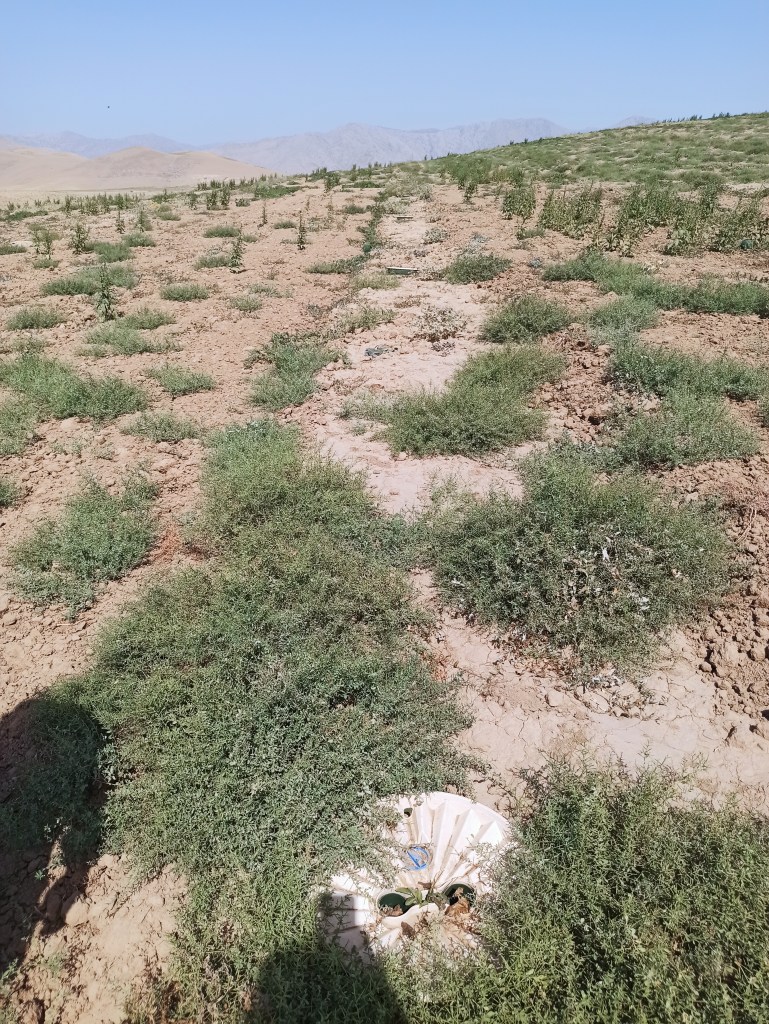
Lands of Sharafiddin-aka
But see what kind of land he has and what kind of land is around.
There, in the distance, a cement plant is being built.
But you can understand what kind of climate and what kind of land it is by looking at the photo.
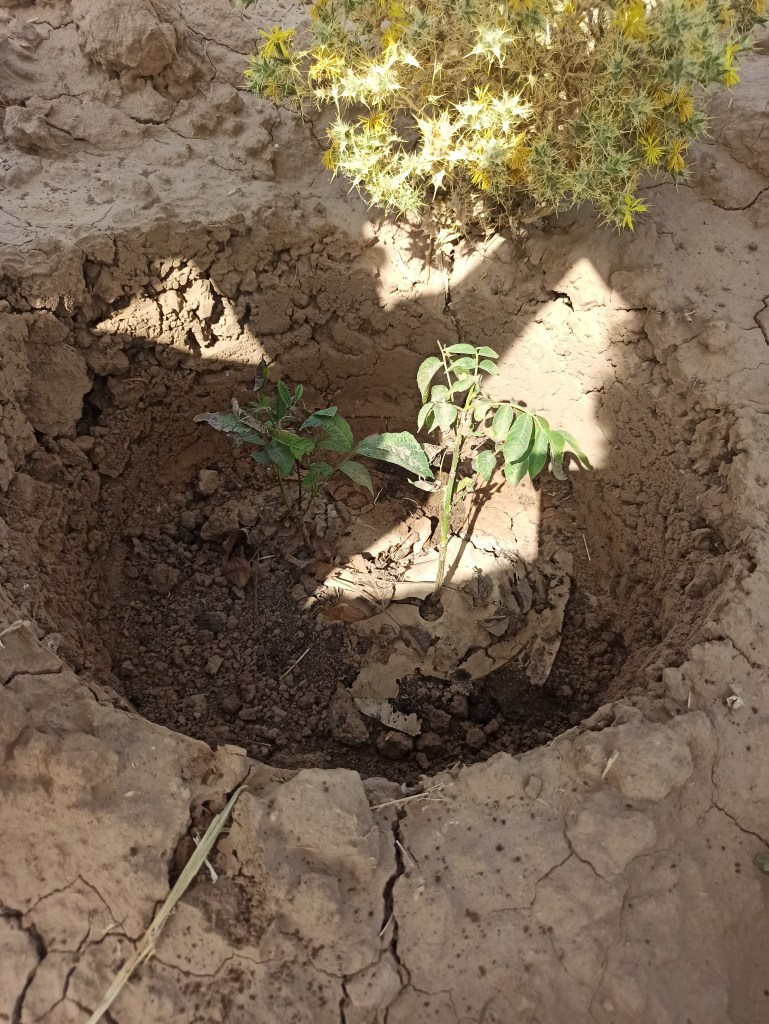
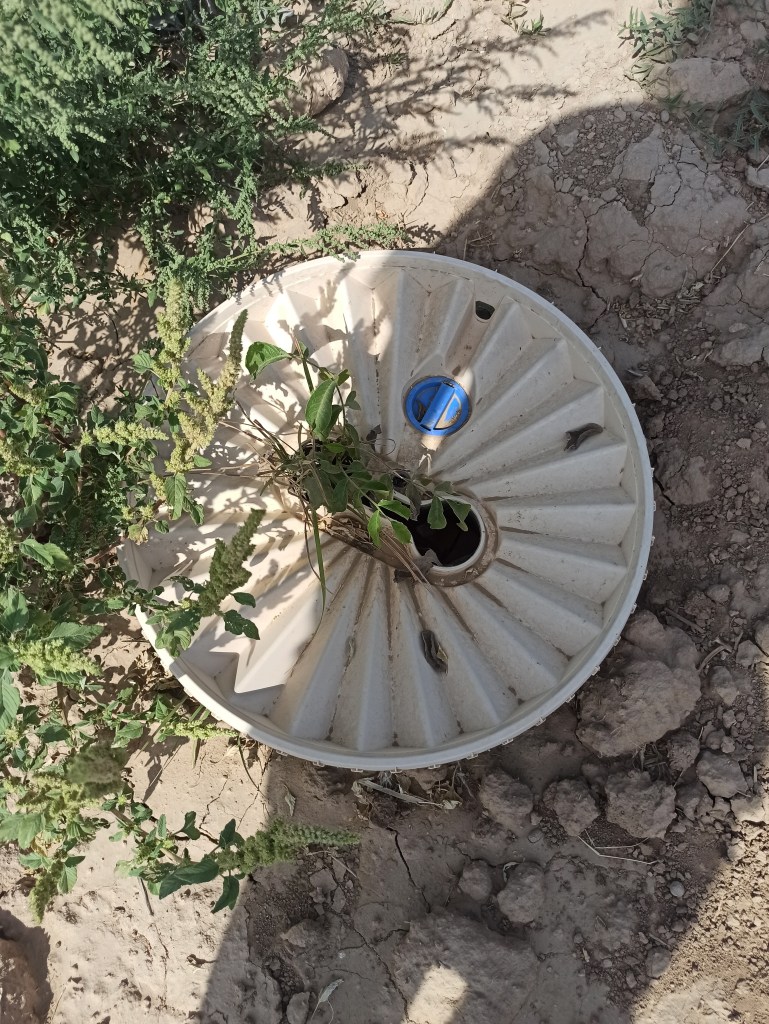
This is what the Waterboxx looks like. You see that the seedlings have taken root, although this is not the kind of tree that should grow here. More on that later. In this photo, walnut seedlings.
We lifted the box, and as you can see, the ground under the box is slightly damp, unlike the ground around. This moisture is enough for the seedling to grow.
You can also see that there is still water in the box. Sharofiddin-aka never filled the box, except for the first time. It has rained twice since planting. He topped up boxes with water a few times, and not because the boxes ran out of water, but simply to be on the safe side.
Unfortunately, it must be said that Sharofiddin-aka did not consult with the foresters and did not follow the advice to plant drought-resistant tree species. After all, after the boxes are removed, the young tree will still have to survive in these harsh conditions. Without abundant watering, moisture-loving crops will not survive here.
Sharafiddin-aka, planted 1200 seedlings:
400 almonds, 400 walnuts, and 400 cherry trees.
He thought that since cherry grows below, in the village, it will grow here, at the top of the hill. But in the village, in the courtyards, people are constantly watering the trees, and there, thanks to buildings, other plants, there is much more moisture in the soil than on an open hill. Walnut is also a very moisture-loving plant, and cannot grow in dry conditions. Do not plant walnut in dry conditions. It’s just not wise. Here, notice where the walnut grows in the wild itself. It grows on the northern slopes, where there is more moisture. So this is its comfortable habitat. It is not intended for dry open areas. But what was planted was planted.
From the results:
Of the 400 cherry seedlings planted, not a single one survived. Walnut – half survived – 200 pcs. But almonds, which are quite drought-resistant, showed a better result – 300 seedlings survived, i.e. 75%.
We suggest Sharofiddin-aka to plant almonds and pistachios, as the most suitable crops for this area and climate. Let’s see how he follows our advice.
Next year, we’ll see how things go with the Bakhmal project. We will keep you updated.
Новая технология позволяет выращивать леса даже в пустыне
Инновационное устройство под названием Groasis Waterboxx позволяет выращивать растения в экстремальных условиях. Даже в пустыне Сахара выживают около 90 процентов высаженных растений. На вид Waterboxx похожий на ручную сушилку для овощей и фруктов, только без крышки. Это устройство позволяет выращивать деревья и кусты в местах, где нет воды и превращать пустыню в оазис.Голландский изобретатель Петер Хофф разработал инновационное устройство под названием Groasis Waterboxx. Оно позволяет выращивать растения в экстремальных условиях. Даже в пустыне Сахара выживают около 90 процентов высаженных растений. На вид Waterboxx похожий на ручную сушилку для овощей и фруктов, только без крышки. Это устройство позволяет выращивать деревья и кусты в местах, где нет воды и превращать пустыню в оазис.
Waterboxx – это безполивний инкубатор, который собирает воду из ночной росы или осадков, после чего питает ею саженец в течение достаточно длительного времени. Контейнер также предотвращает испарение воды и защищает корни от солнца и от мелких грызунов, сохраняет постоянную температуру корневища, что позволяет деревьям свободно расти. Благодаря Groasis Waterboxx, саженец больше не нуждается в посадочной ямы: капиллярные корешки всегда будут в целостности, что позволит им регулярно и в нужном объеме передавать будущему дереву влагу.
Каждый саженец крепится на тканевой или картонной подложке внутри контейнера и влага поступает к корням капиллярным путем. Система состоит из цилиндрических корпуса, в котором находится около 15 литров воды, а крышка в виде перевернутого конуса позволяет захватывать стоки внутрь корпуса. В случае обильных осадков, устройство имеет питательный клапан, который вытягивает лишнюю воду. Внутри каждого контейнера есть место для посадки двух саженцев.
За последние пять лет система Waterboxx успешно внедрена на пяти безжизненных участках – пустынях и бывших карьерах общей площадью в 65 га и выживаемость растений составляла 80-90 процентов, хотя ранее здесь не приживалось и 5 процентов деревьев.
Регулярный контроль за ростом растений проводился с помощью дронов-беспилотников, которые сканировали участки с помощью тепловизоров. Так удалось вырастить более 25 сортов деревьев и кустов и существенно увеличить биоразнообразие на практически безжизненных просторах. Первый прототип устройства изготовлен из пластика, но его быстро заменили на переработанный картон, который значительно удешевил производство. Это изобретение может помочь бороться с жарким и сухим климатом.
Источник — http://arabmir.net/node/3984 К сведению читателей, в источнике есть видео с комментарием на английском.
What are 5 everyday things that bring you happiness? As a nature lover, I derive joy and happiness from movement and contemplation experiencing a beautiful landscape, watching plants, trees, flowers, insects, birds, sky, and clouds, feeling wind under my wings as I walk.
The text below was largely composed in November 2006. The Russian version of “Main Findings” is based on a seminar given in the Theoretical Physics Division of Petersburg Nuclear Physics Institute in January 2008. The English and Russian versions are somewhat different in structure. Besides, Russian version contains an additional section on hurricanes.
The main problem with water on land is that it cannot be accumulated there once and for all. As far as the landmasses are elevated above the sea level, all water accumulated on land in soil, lakes, rivers, glaciers etc. ultimately leaves to the ocean under the force of gravity. To keep land moistened and, hence, terrestrial life thriving, it is necessary to continuously compensate the gravitational runoff of water from the continents by a reverse, ocean-to-land, atmospheric moisture flow. If there is no influx of atmospheric moisture to land from the ocean, all water accumulated on land in soil, lakes and rivers will be lost via runoff in but a few years!
Fig. 1. Regions of the world where the dependence of precipitation on distance from the ocean was studied.
Moisture evaporated from the oceanic surface is delivered to land by winds. As the moisture-laden oceanic air flows inland from the coast, some of its moisture precipitates and is lost to runoff. Therefore, from the geophysical point of view, the deeper inland, the less the moisture content of the flow, the less the rainfall.
This pattern is indeed observed in deforested regions over the globe. Using the rainfall station data we found that annual precipitation P (mm year−1) on territories deprived of natural forest cover decreases exponentially with distance xfrom the ocean with an e-folding length of no more than several hundred kilometers, Fig. 2a. This means that the passive geophysical atmospheric flows can only moisten a narrow band of land near the coast. The much more extensive inner parts of the continents invariably remain arid.
Fig. 2. Annual precipitation P versus distance x from the source of moisture on deforested territories (a) and in natural forests (b).
In sharp contrast with this pattern, precipitation over territories covered by the remaining natural forests of the Earth (Amazonia, Equatorial Africa, Siberia) does not decrease with distance from the ocean and may even grow over several thousand kilometers, Fig. 2b.
From the purely geophysical point of view, this remarkable phenomenon is quite unexpected and unexplainable. For example, the innermost part of the deforested North-East China (region 2 in Figs. 1 and 2a) at about 2000 km from the Pacific ocean coast receives as little as 100 mm annual precipitation. For comparison, the innermost part of the Yenisey river basin covered by extensive natural forests (region 8 in Figs. 1 and 2b) is many thousand kilometers away from any of the oceans, representing one of the innermost continental areas on the planet, see Fig. 1. In spite of this unfavorable geophysical position, the upper reaches of Yenisey receive as much as 800 mm annual precipitation, and the forests flourish.
High precipitation creates high soil moisture content, which, in its turn, maximizes biological productivity. With natural selection coming into play, higher productivity is associated with higher competitive capacity. Therefore, evolution of terrestrial life forms can be expected to culminate in a state when entire continents are covered by ecosystems functioning at a maximum possible power limited by solar radiation only. In such a state soil moisture content and, hence, local water losses to runoff, should be equally high at any distance from the ocean. This means that the most productive, most competitive ecological communities (i.e. forests) must be able to transport moisture inland from the ocean in quantities sufficient for compensation of the high runoff losses associated with the high soil moisture content. The existence of such forest moisture pumps resolves the geophysical enigma of high precipitation and intense water cycles in the inner parts of the forest-covered continents.
Fig. 3. Water vapor partial pressure and the evaporative force in the terrestrial atmosphere as dependent on atmospheric height z. (a)Saturated partial pressure of water vapor pH2O(z) and weight of water vapor Wa(z) in the atmospheric column above height z at the observed mean tropospheric lapse rate of 6.5 oC km−1. (b) The upward-directed evaporative force f equal to the difference of the upward directed pressure gradient force f↑, which is associated with the non-equilibrium vertical distribution of the atmospheric water vapor, and the downward directed weight f↓ of a unit volume of the saturated water vapor.
Having established that the forest pumps of atmospheric moisture must exist, it was necessary to investigate the physical principles of their functioning. These proved to be non-trivial. Atmospheric air is in approximate hydrostatic equilibrium, which means that at any height z air pressure is balanced by the weight of atmospheric column above z. In contrast, atmospheric water vapor is out of hydrostatic equilibrium. At any height z the partial pressure of water vapor is about four times larger than the cumulative weight of water vapor above z, Fig. 3a. This effect, well-known from observations but so far unappreciated in its importance, has to do with the observed vertical gradient of atmospheric temperature, which decreases with height by approximately 6.5 oC km−1. Water vapor is a condensable gas. The maximum amount of water vapor that can be held in the air exponentially declines with decreasing air temperature. Hence, when the air temperature drops sufficiently rapidly with height, the upper atmosphere appears to be so cold that it cannot hold enough water vapor for its weight to balance the high partial pressure of water vapor in the lower, warmer atmosphere.
As far the cumulative pressure of the moist air exceeds the weight of atmospheric column, there appears an upward-directed force, Fig. 3b, which causes air and water vapor to ascend. At the surface, the ascending air volumes must be replaced by the air flowing horizontally from the neighboring areas into the region of ascent. Provided they are appropriately directed, these horizontal air fluxes can be used by the biota to transport of moisture from the ocean.
When the water vapor ascends, it enters the cooler upper atmospheric layers, condenses and precipitates. The upward-directed force driving the ascending and, hence, horizontal, air motions is caused by the vertical distribution of water vapor, so when the amount of water vapor in the atmosphere diminishes, the force diminishes as well and the atmospheric motions slow down. The stationary value of this force, which can be termed the evaporative force, is determined by the rate at which water vapor is added into the atmosphere to compensate for its condensation, i.e. by the rate of evaporation. Based on these physical considerations, the fundamental physical principle can be formulated that horizontal fluxes of air and water vapor are directed from areas with weaker evaporation to areas with stronger evaporation.








 Green Light Deserts LTD