More than 85%[1] of the total territory of Uzbekistan (448,978 sq. km) is occupied by deserts and semi-deserts. It is these massive tracts of bare land that are the most significant sources of soil organic carbon (SOC) and СО2 emissions into the atmosphere compared to other sources due to sand dust storms[2] [3].
Droughts and scarce water supply lead to further desertification and dust storms, which have become more frequent in recent years. Currently, the dynamic of desertification is such that every minute quite a few square meters of land are added to the deserts in Uzbekistan.[4] Desertification in urban and agricultural areas is mainly manmade, which means it can be stopped and reversed. Dust, which raises into the air from desert and semi-desert soil settles in the lungs of people, in water, agricultural crops and all vegetation, dealing a lot of harm to the available resources and all people without exception even those who live in relatively comfortable urban conditions, let alone rural residents, especially those who live in the deserts, semi-deserts, steppe zones, and the Aral Sea basin. In addition to that, the glaciers storing freshwater reserves in the mountains of Tyan-Shan are melting too fast without sufficient natural replenishment due to climate change[5]. Also, the region of Central Asia will eventually face the consequences of the large-scale tree-cutting and wildfires in the taiga forests of Siberia, which are emitting tonnes of СО2 into the atmosphere in the form of tinder depletion, smoke, soot, and which are gradually leading to partial desertification of the places, which used to be forests.
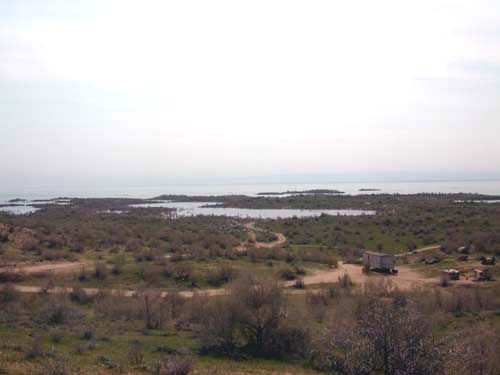
However, it is necessary to note that the main source of СО2 rising into the atmosphere is the open soil, the ground that is deprived of its cover whether vegetational or other. Arable farming also leads to massive loss of the organic layer due to the flight of the carbon into the atmosphere because of the perennial root elimination.[6] Gusts of wind raise into the atmosphere billions of tonnes of organic carbon, which is the essential component of the soil. The degradation of soils from unsustainable agriculture and other development has released billions of tons of carbon into the atmosphere.[7]
The attention given to the climate change in the world and significant funding allocated to tackle climate change open opportunities for Uzbekistan to solve the abovementioned issues.
Based on the international practices and the national experience accumulated in Uzbekistan it was possible to develop and formulate a sustainable solution of the above-mentioned problems, which takes into consideration all aspects of the situation, such as an on-going desertification, water scarcity, air pollution, CO2 emissions, need for green jobs, green economy leading to a radical improvement of the situation in the foreseeable future.
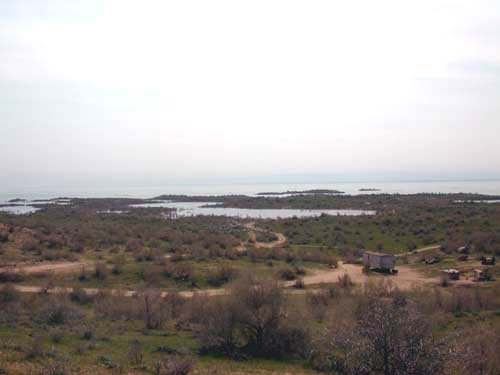
National experience. Afforestation of the dried bottom of the Aral Sea as part of the action to mitigate the consequences of the environmental catastrophe is a good example of an enormous effort undertaken in a short period of time. It not only strives to catch up with the rapid pace of the climate change but also shows how much more needs to be done in the years to come. It is an excellent national pilot, which provides evidence-based results and lessons learnt opening avenues for scaling up the effort. In particular, the results of the aerial sowing method of the haloxylon plantations exceeded the outcomes of other methods by tens and hundreds of times proving to be much more cost-effective and less invasive for the soil, enabling faster and stronger growth of roots as compared to mechanical seeding or manual plantation of saplings in the sand furrows.[8]
International experience. Aerial sowing is very much in agreement with the method of afforestation in the so-called Green Belt of the Sahara Desert and other arid and semi-arid territories of Africa, India, and China. However, the aerial sowing in Africa and India is done with seed balls, or soil capsules with seeds of endemic trees, shrubs, and grass inside them. Since the ancient times, seedballs helped to protect future crops from birds and rodents and emulated enhanced natural conditions of growth for the seeds. Seedballs can be dropped onto the soil in any season of the year where they wait for the right temperature and a modest portion of precipitation to start growing up stems and putting down roots through the capillary ducts in the soil moving towards the deeper water aquifers. The composition of the soil for seedballs is very basic and may or may not include charcoal dusts, hummus, or other enriched protective mixtures.
Currently Uzbekistan is working on the National Climate Change Mitigation Strategy until 2030, which will add to other important government directives in line with international cooperation and economic development while addressing environmental challenges[9]. However, the key to the solution of the problem of ameliorating and restoring the climate, the air and water quality, and land resources is the large-scale forestation of the whole territory of Uzbekistan.
It is not surprising that Bhutan[10] and Suriname[11] – two countries in the world with negative CO2 emissions are entirely covered with forests. To retain the carbon neutrality while developing the economy, it is necessary to design the development in such a way that carbon, which is the most important and precious natural element of life, is kept in the right places[12].
[1] According to the reliable data, more than 85% of the territory is affected by desertification not including the tugai and mountainous areas. Presentation of the report. https://unece.org/sites/default/files/2020-12/FR-Uzbekistan_Zakhadullaev_workshop%209%20December%202020.pdf
[2] McMahon, J. (2019) Why Agriculture’s Greenhouse Gas Emissions Are Almost Always Underestimated.
[3] Guo, M. et al (2012) The effects of sand dust storms on greenhouse gases. International Journal of Remote Sensing. https://www.researchgate.net/publication/254314458_The_effects_of_sand_dust_storms_on_greenhouse_gases
[4] Intensive desertification of the territory of Uzbekistan: causes, consequences, and solutions Интенсивное опустынивание территории Узбекистана: причины, последствия и выход (kun.uz)
[5] Chen, Y. et al. (2018) Satellite-based evaluation of the changes of glacial and terrestrial total water storage in the Tien Shan Mountains, Central Asia. https://ui.adsabs.harvard.edu/abs/2018AGUFMGC52C..02C/abstract#:~:text=The%20glaciers%20in%20Asia’s%20Tian,on%20water%20utilization%20and%20sustainability.
[6] Ontl, T.A. (2012) Soil Carbon Storage. Nature Education. https://www.nature.com/scitable/knowledge/library/soil-carbon-storage-84223790/
[7] Schwartz, J.D. (2014) Soil as Carbon Storehouse: New Weapon in Climate Fight? Yale Environment 360 Newsletter. Yale School of the Environment. https://e360.yale.edu/features/soil_as_carbon_storehouse_new_weapon_in_climate_fight
[8] Novitsky, Z. (2021) Green shield of the dried bottom of the Aral Sea. Publication dated 30 April 2021. https://www.gazeta.uz/ru/2021/04/30/aral-sea-region/
[9] In Uzbekistan, the foundation of the state policy on climate change consists of the Constitution of the Republic of Uzbekistan, UN Framework Convention on Climate Change, Paris Agreement on Climate Change, normative-legislative acts signed by the President and the Government of the Republic of Uzbekistan, such as, Law of the Republic of Uzbekistan “On the ratification of the Paris Agreement” (№ЗРУ-491 dated 02.10.2018.) https://lex.uz/docs/3924451 ; Law of the Republic of Uzbekistan “On the Use of the Renewable Energy” (№ЗРУ-539 dated 21.05.2019.) https://lex.uz/docs/4346835 ; Decree of the President of the Republic of Uzbekistan “On the adoption of the Concept of Environmental Protection of the Republic of Uzbekistan till 2030” (№УП-5863 dated 30.10.2019) https://lex.uz/ru/docs/4574010; Resolution of the President of the Republic of Uzbekistan “On the adoption of the Strategy of the Republic of Uzbekistan on Transition to “Green” Economy for the Period 2019-2030 (№ПП-4477 dated 04.10.2019.) https://lex.uz/ru/docs/4539506 ; Resolution of the Cabinet of Ministers of the Republic of Uzbekistan “On measures for Implementing the National Sustainable Development Goals and Targets” (№ПКМ-841 dated 20.10.2018) https://lex.uz/ru/docs/4013358 . Decree of the President of the Republic of Uzbekistan on the adoption of the agricultural development strategy for the period from 2020 to 2030 №УП-5853 dated 23.10.2019 https://lex.uz/ru/docs/4567337
[10] Munawar, S. (2016) Bhutan Improves Economic Development as a Net Carbon Sink. The Climate Institute.
[11] Suriname’s climate promise, for a sustainable future (2020) https://news.un.org/en/story/2020/01/1056422
[12] McDonough W. (2016) Carbon is not the enemy. Design with the natural cycle in mind to ensure that carbon ends up in the right places. https://www.nature.com/articles/539349a

 Green Light Deserts LTD